
Interview with Tatò Carla
ORMT-18v
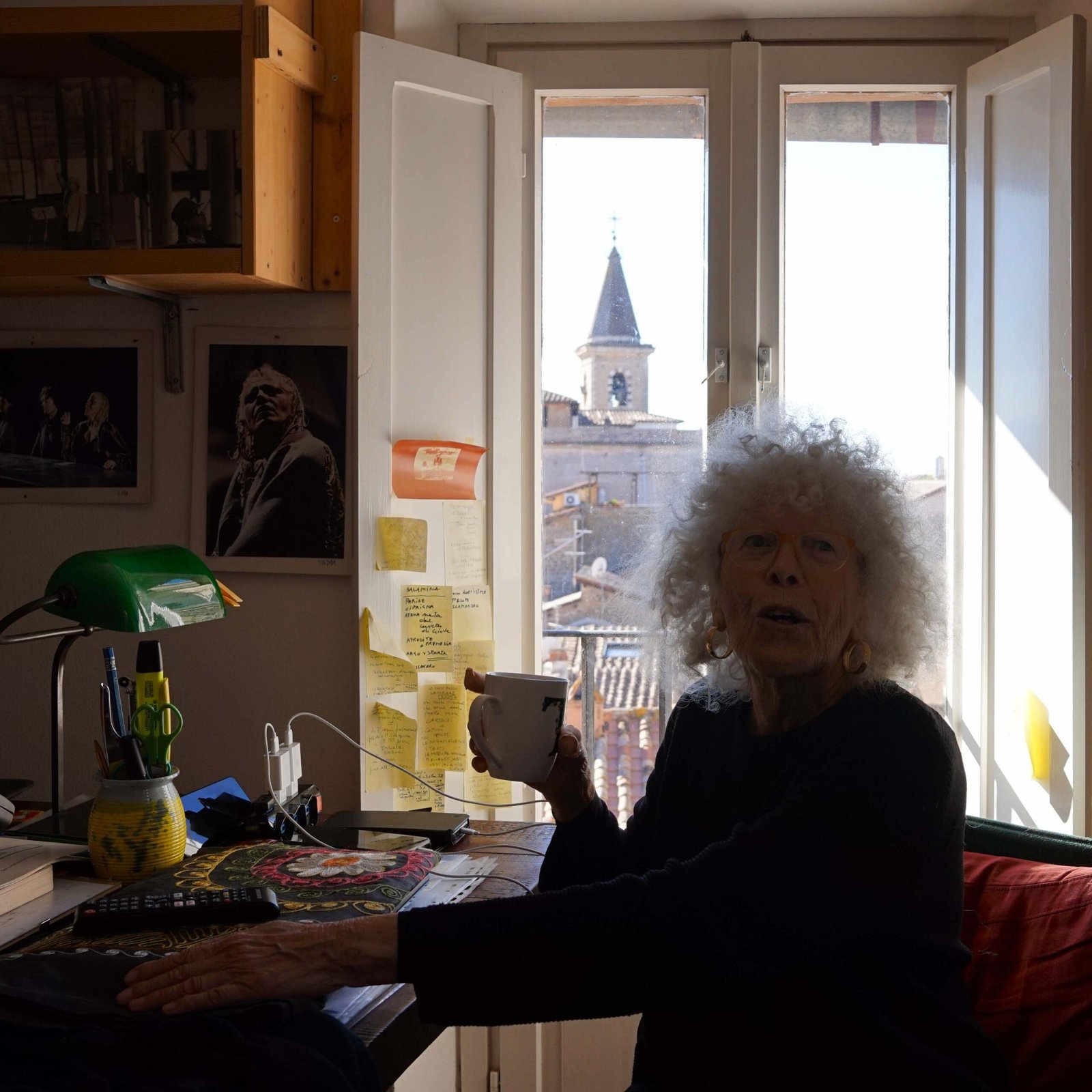
Interviewee: Tatò Carla
Interviewer: Orecchia Donatella
24 November 2024 – Carla Tatò’s house, Genazzano, Rome
Late 1970s – Early 1980s
Keywords
- Abramović Marina
- Ashley Robert
- Benjamin Walter
- Bennink Ham
- Branciaroli Franco
- Brega Piero
- Castellitto Sergio
- Celant Germano
- Cinque Luigi
- Coen Massimo
- Colombaioni Willi
- Colombo Eugenio
- Conti Bicocchi Maria Gloria
- Coudray Michelle
- Cutarelli Dino
- de Sade Donatien-Alphonse-François
- Dell’Orso Edda
- Fabbri Marisa
- Fabro Luciano
- Fuchs Rudi
- Geremia Renato
- Gianelli Ida
- Gordon Peter
- Hermann Nitsch
- Jonas Joan
- Kounellis Jannis
- Laysiepen Uwe
- Lerici Roberto
- Lessing Gotthold Ephraim
- Marini Giovanna
- Marlowe Christopher
- Mengelberg Misha
- Michetti Ulderigo
- Morricone Ennio
- Neumann Andrés
- Paolini Giulio
- Pellion Paolo
- Petroselli Luigi
- Piperno Giacomo
- Pirandello Luigi
- Prasca Giuliano
- Proietti Gigi
- Quartucci Carlo
- Quartucci Toto
- Saffo
- Scalchi Ada
- Schiaffini Giancarlo
- Tatò Carla
- ten Cate Ritzaert
- Van Tieghen David
- von Kleist Heinrich
- Wedekind Frank
- 1793, da Parigi by Fuchs Rudi
- Borgatacamion by Camion (directed by Quartucci Carlo)
- Comédìe Italienne by Lerici Roberto, Paolini Giulio and Quartucci Carlo
- Didone by Lerici Roberto (directed by Quartucci Carlo)
- Florville and Courval by de Sade François (directed by Quartucci Carlo)
- Funerale by Lerici Roberto and Kounellis Jannis (directed by Quartucci Carlo)
- Il fuoco che genera fumo. Il fumo che genera ballerina. Ballerina che genera galli by Kounellis Jannis
- Histoire du soldat by Stravinskij Igor Fёdorovič (directed by Quartucci Carlo)
- L’ultimo spettacolo di Nora Helmer by Camion (directed by Quartucci Carlo)
- Pentesilea by von Kleist Heinrich (directed by Quartucci Carlo)
- Platea by Paolini Giulio and Quartucci Carlo
- Prologo by Paolini Giulio
- Robinson Crusoe mercante di York by Camion (directed by Quartucci Carlo)
- Scene di Periferia by Quartucci Carlo
- Tamerlano Il Grande by Marlowe Christopher (directed by Quartucci Carlo)
- Un teatro musicale - Concerto scenico by Bennink Ham, Colombo Eugenio, Mengelberg Misha and Geremia Geremia
- Uscite by Kounellis Jannis and Quartucci Carlo
- Castello Colonna, Genazzano (RM)
- Genazzano (RM)
- Ninfeo del Bramante, Genazzano, (RM)
- Progetto Genazzano
DESCRIPTION 00:00:00 – 00:09:00 The debate on postmodernism and the positioning of Genazzano Project.
Preliminary introductions. D.O. Donatella Orecchia introduces the debate on postmodernism in the early 1980s, referring to the Italian reception of Jean-François Lyotard’s The Postmodern Condition, the activities of the journal “Alfabeta”, the conference on postmodernism organized by Giuseppe Bartolucci, and the emergence of a new generation of theatre groups characterized by different poetics and working methods. She asks how Carlo Quartucci, Carla Tatò, Jannis Kounellis, and Germano Celant positioned themselves in relation to this context.
C.T. Carla Tatò reconstructs the network of intellectual and critical relationships surrounding Carlo Quartucci’s work and the Zattera di Babele, recalling figures such as Giuseppe Bartolucci, Edoardo Fadini, Achille Mango, Franco Quadri, and other interlocutors involved in contemporary theatre research. She distinguishes the role of critics as companions and witnesses to artistic processes, highlighting the different approaches of Bartolucci, Fadini, and Mango.
She also recalls the emergence of groups such as La Gaia Scienza and Magazzini Criminali, interpreting them as part of the same climate of experimentation. She describes Quartucci and Tatò’s work as a process grounded in the shared discovery of people, places, spaces, and relationships, in which each performance constituted a fragment of an ongoing and evolving research project. In Genazzano, this reflection continued through an intense exchange, both public and private, with figures such as Edoardo Fadini, Achille Mango, and Germano Celant.
Finally, she refers to the debate on the so-called “return to painting”, associated with Achille Bonito Oliva’s Transavanguardia, contrasting it with the research into fragmentation and processual continuity developed by the Genazzano Project group.
00:09:01 – 00:12:18 Drammaturgia delle Arti and the relationship with the new generations of theatre-makers.
D.O. Donatella Orecchia recalls the contrast between Germano Celant’s and Achille Bonito Oliva’s positions in the artistic debate of the early 1980s and asks about Carlo Quartucci and Carla Tatò’s attitude towards the new generations of theatre-makers. C.T. Carla Tatò identifies Drammaturgia delle Arti as the theoretical principle that distinguishes Quartucci’s and the Zattera di Babele’s approach, based on attributing an authorial function to the scenic space, conceived as an active element in the construction of dramaturgy.
With regard to Magazzini Criminali, she acknowledges a difference in poetic and methodological terms, clarifying that this did not amount to a polemical opposition, but rather reflected the coexistence of different artistic trajectories. She also emphasizes that working with space required a constant willingness to relinquish, listen, and transform the creative process, invoking in this regard Beckett’s principle of “failing better”.
00:12:19 – 00:16:05 The political and cultural crisis of the 1980s and Quartucci and Tatò’s trajectory.
D.O. Donatella Orecchia asks whether Carlo Quartucci and Carla Tatò, as artists connected to a specific political and cultural tradition, perceived the crisis of the grand ideologies that characterized the Western world in the early 1980s. C.T. Carla Tatò refers to the experience of Gruppo 63 and the continuity of their relationships with Edoardo Sanguineti, recalling how travel and scenic research were indispensable elements of their artistic trajectory.
She also recalls the formation of different critical and cultural networks, associated respectively with Franco Quadri, Giuseppe Bartolucci, Germano Celant, and Achille Bonito Oliva. She emphasizes that Carlo Quartucci and Carla Tatò preferred to remain outside established structures of affiliation, prioritizing artistic practice, project-based work, and the development of working relationships.
00:16:06 – 00:21:24 The encounter with Rudi Fuchs and the international expansion of Genazzano Project.
D.O. Donatella Orecchia introduces the subject of Rudi Fuchs’s involvement in Genazzano Project, questioning whether this encounter marked a shift towards a more distinctly European cultural horizon in comparison with the earlier international network developed also through Germano Celant. C.T. Carla Tatò describes her encounter with Rudi Fuchs as a genuine “love at first sight”, emphasizing that their relationship with contemporary art was conceived not merely as an engagement with individual artists, but as an opening towards a broader international cultural community.
She reconstructs her first meeting with Fuchs and highlights his direct participation in the collective working sessions of Genazzano Project, recalling, among other episodes, the site visit to the Ninfeo del Bramante shared with Carlo Quartucci and Carla Tatò.
End of the interview.
Go to Biography
Interview Duration: 06:00:00 approximately
Registration Duration: 00:21:24
Format: mp3
Type: Audio
Language: Italiano
Subjects:
Original Document Placement:- Museo Biblioteca dell’Attore
- ICBSA, Via Caetani 32, 00186, Roma
Usage and Rights:Any use of the material different from listening (except short quotation) is not possible without the prior written consent of ECAD/ORMETE.
Any use of the material different from listening (except short quotation) is not possible without the prior written consent of ECAD/ORMETE.
Citation
Interview with Tatò Carla, conducted by Orecchia DOnatella and Morganti Arianna, at Carla Tatò’s home in Genazzano (RM), on 24 November 2024, “Progetto Genazzano (1981–1984)”, Ormete Collection (ORMT-18v), consulted in URL:< https://patrimoniorale.ormete.net/progetto/progetto-genazzano-1981-1984/ >, (access date).
Relation: Bibliography: