
Interview with Tatò Carla
ORMT-18c
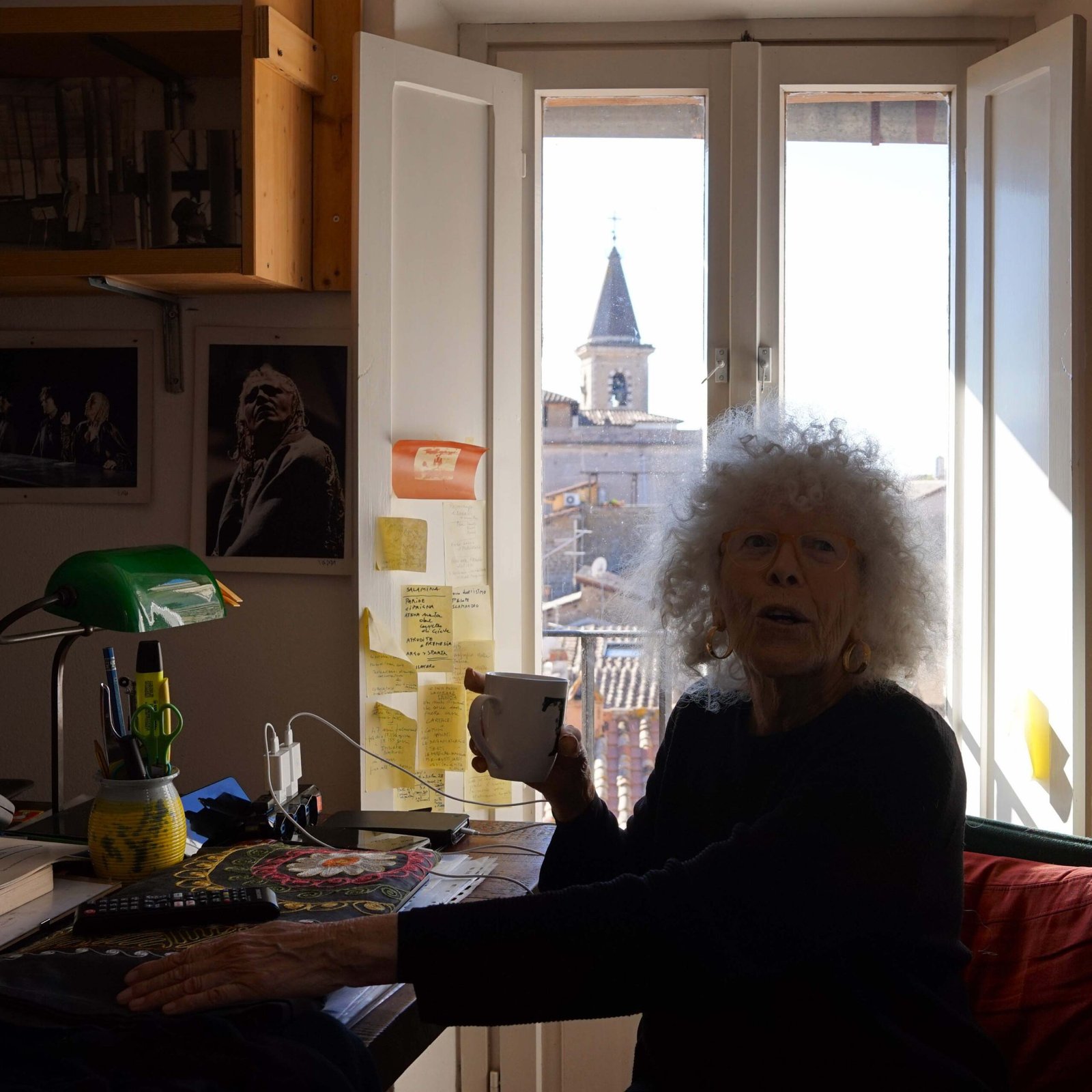
Interviewee: Tatò Carla
Interviewer: Davies Massimiliano Morganti Arianna
Davies Massimiliano Morganti Arianna
16 July 2023 – Carla Tatò’s house, Genazzano, Rome
Early 1980s
Keywords
- Abramović Marina
- Benjamin Walter
- Bennink Ham
- Branciaroli Franco
- Brega Piero
- Casamonica Enrico, detto “Ringo”
- Celant Germano
- Cinque Luigi
- Colombo Eugenio
- Conti Bicocchi Maria Gloria
- Coudray Michelle
- Cutarelli Dino
- de Sade Donatien-Alphonse-François
- Fabro Luciano
- Filippini Enrico
- Geremia Renato
- Géricault Théodore
- Gianelli Ida
- Kounellis Jannis
- Lerici Roberto
- Lessing Gotthold Ephraim
- Marini Giovanna
- Mengelberg Misha
- Michetti Ulderigo
- Neumann Andrés
- Panepuccia Cesare
- Paolini Giulio
- Pellion Paolo
- Petroselli Luigi
- Piperno Giacomo
- Poe Amos
- Prasca Giuliano
- Proietti Gigi
- Quartucci Carlo
- Quartucci Toto
- Scalchi Ada
- Tatò Carla
- Borgatacamion by Camion (directed by Quartucci Carlo)
- Comedie Italianne by Paolini Giulio and Quartucci Carlo
- Il fuoco che genera fumo. Il fumo che genera ballerina. Ballerina che genera galli by Kounellis Jannis
- L’ultimo spettacolo di Nora Helmer by Camion (directed by Quartucci Carlo)
- Prologo by Paolini Giulio
- Robinson Crusoe mercante di York by Camion (directed by Quartucci Carlo)
- Uscite by Kounellis Jannis and Quartucci Carlo
- Arancera di San Sisto Vecchio, Roma
- Castello Colonna, Genazzano (RM)
- CCPD - Centro culturale polivalente decentrato, Roma
- Genazzano (RM)
- Mickery Theatre, Amsterdam
- Nettuno (RM)
- Ninfeo del Bramante, Genazzano (RM)
- Romanina, quartiere della città metropolitana di Roma
- Cabaret degli undici boia
- Cabaret Voltaire
- Compagnia Laboratorio di Camion
- Pappagallo Verde
- Zattera di Babele
| DESCRIPTION | ||
| 00:00:00 – 00:06:50
Leaving Rome and discovering Genazzano. |
A.M. Arianna Morganti invites Carla Tatò to reflect on the transition from the nomadic experience of Camion to the arrival in Genazzano, asking what intention lay behind the move from an urban context such as Rome to a rural, peasant context such as Genazzano.
C.T. Carla Tatò recalls arriving in Genazzano carrying the theatrical trilogy (Scene di teatro – L’ultimo spettacolo di Nora Helmer; Scene di romanzo – Il mito di Robinson Crusoe; Scene di periferia – Borgatacamion). In 1979, the encounter with Renato Nicolini had taken place at the Aranciera di San Sisto Vecchio. After the experience at San Sisto Vecchio, which she describes as a “scenic miracle”, the need arose to move away from Rome and from a “traditional” stage. Councillor Ada Scalchi proposed that they travel through the surrounding towns, from Nettuno to Ardea. Carlo Quartucci and Carla Tatò arrived with the Camion and experimented with “unspeakable things”. Their arrival in Genazzano happened “completely by chance”. They immediately began exploring Castello Colonna, where they were welcomed by Mayor Ulderigo Michetti and Councillor for Culture Dino Cutarelli, who invited them to stay: “they immediately told us to stay, why don’t you stay?” (00:05:48). At the time, the Castello was a ruin. “We began to stay” (00:06:48 – 00:06:50). |
|
| 00:06:51 – 00:12:28
Arrival in Genazzano and proximity to peasant culture. |
C.T. Carla Tatò recalls the first action carried out in Genazzano: the film Florville e Courval, based on De Sade’s The 120 Days of Sodom, shot in the habitable sixteenth-century rooms of Castello Colonna. Some fragments of Pentesilea were subsequently filmed, together with Enrico Filippini, with whom they participated in the 1981 Festival dei Teatri Stabili di Firenze.
Over the course of two years, a creative situation developed in the spaces of Genazzano involving critics, scholars, poets, painters, theatre practitioners, musicians, dancers and acrobats: “they were a sea, thinking, exchanging, the town was very alive because peasant culture was expressing itself” (00:08:32 – 00:08:45). She recalls the wine festival, Vinaliae. The concept of “cultural intervention” derives from the practice of grafting grapevines. The actions that emerged in Genazzano are connected to their proximity to and affinity with peasant culture. The Sala Martino V was divided in two and experienced according to a conception comparable to Elizabethan theatre, with the scenic action taking place simultaneously above and below. “We experienced this Castello by celebrating its construction, its original state, and giving it a new perspective” (00:11:50 – 00:12:02). The importance of the relationship with the ancient is emphasised: starting from the remote in order to arrive at the contemporary. |
|
| 00:12:29 – 00:18:53
Inside and outside Genazzano. The Teatroteca and the relationship between artists and the peasant community. |
M.D. Massimiliano Davies observes that, at the beginning of the 1980s, Genazzano appeared apparently isolated, but was, from the perspective of administrative and cultural policies as well as logistically, more closely interconnected with the city.
C.T. Carla Tatò recalls an action carried out with the old Rome-Fiuggi railway, a train that “sculpts the nature of Genazzano”. M.D. Massimiliano Davies describes Genazzano as a small, compact universe, simultaneously characterised by an international openness. C.T. Carla Tatò insists on the dimension of exchange: giving and receiving, entering and leaving. Genazzano, a small town of approximately 5,000 inhabitants, was characterised by a strong peasant culture. The artists reinforced its sense of cohesion. The Teatroteca at Castello Colonna became a shared space where people drank and ate, films were screened and ideas discussed, in a “contagious creative exchange”. A creative atmosphere thus developed that remained respectful of peasant culture. |
|
| 00:18:54 – 00:24:32
The active involvement of the Genazzano community and the cultural intervention. |
A.M. Arianna Morganti asks how the community was actively involved in the project.
C.T. Carla Tatò recalls how the project was constructed together with the inhabitants, beginning, for example, with the Sala Martino V. Jannis Kounellis’s idea for the curtain made of wine glasses emerged from the days spent together with the peasant community and from visits to the vineyards. |
|
| 00:24:33 – 00:29:46
Arrival at the Ninfeo del Bramante and Luciano Fabro’s Genealogia. |
C.T. Carla Tatò recalls arriving at the Ninfeo del Bramante, a space profoundly different from Castello Colonna, which she describes as the “witches’ wood”. The Ninfeo was cleared of vegetation, making it accessible through a wooden structure intersecting with the layer of grass, a “wooden carpet”.
She then describes Luciano Fabro’s Genealogia. Loudspeakers were installed throughout the town, extending from the Castello to the town gate, and were used, according to an agreement between the parish priest and the mayor, to communicate information and appointments to citizens. The same loudspeakers and the civil registry records were used for the artistic action Genealogia. These records contained registrations of births, deaths and marriages of the entire population of Genazzano, from the town’s foundation up to the period of Progetto Genazzano. Meanwhile, Paolo Pellion photographed the inhabitants of Genazzano. The town was thus filled, through the loudspeakers, with all the names of Genazzano. She concludes by recalling the dimension of sonic waiting. |
|
| 00:29:47 – 00:31:40
Giulio Paolini’s Comedie Italienne at the Ninfeo del Bramante. |
C.T. Carla Tatò recalls that, before arriving in Genazzano, Giulio Paolini’s Comédie Italienne had been created using slides depicting the history of Camion, according to a conception of “theatre within theatre”.
In Genazzano, the slides instead depicted close-ups of the town’s inhabitants and were projected onto Giulio Paolini’s curtain. The artists, dressed in eighteenth-century costumes – actors, dancers and musicians – performed among the columns of the Ninfeo del Bramante. |
|
| 00:31:41 – 00:39:24
The relationship with the ancient. |
M.D. Massimiliano Davies identifies one of Carlo Quartucci’s poetic traits in his research into and excavation of the cultural and historical sources of the past, reintroduced into the present through the use of fragments to create a new mythology of the present. Quartucci and Tatò pursued the aim of making Genazzano more aware of its own past.
C.T. Carla Tatò identifies in this relationship with the ancient a driving spark. She traces the concept of the past back to the literal meaning of “past participle of something that happened”. The more appropriate adjective is ancient, understood as a root that remains alive in the present. The ancient is the present: “scenic DNA”. The scenic act evokes what already exists and takes shape as a form of cultural transmission, as in the case of the wine bottles used in Uscite. It is an exchange that generates and regenerates the encounter between two people: artist and peasant. |
|
| 00:39:25 – 00:45:23
Further reflections on the relationship with classical antiquity. |
M.D. Massimiliano Davies further explores the roots of Carlo Quartucci’s aesthetic, philosophical and methodological conception. The present is perceived as emptied out, yet at the same time permeated by fragments of the past, through which it is possible to compose a new construction projected towards the future.
C.T. Carla Tatò recalls the connection with modernist authors and the powerful desire to move beyond them. She also emphasises the relationship with tradition, classical antiquity and Magna Graecia. |
|
| 00:45:54 – 00:53:11
The 1070s: Camion and the Romanina neighbourhood. |
A.M. Arianna Morganti asks Carla Tatò to reconstruct the transition from the 1970s to the 1980s, from travelling with Camion to settling permanently through Genazzano Project.
C.T. Carla Tatò emphasises the absence of propagandistic intentions in the work carried out in the peripheral neighbourhoods of Rome, which they approached professionally by inhabiting and living within neighbourhood committees, street meetings and those held at the CCDP, “it looked like a Russian inscription”, the Centro Culturale Polivalente Decentrato, at 30 Via Leopoldo Migucci in the Romanina neighbourhood. She recalls Borgatacamion, whose film opens with Enrico Casamonica’s statement “they have looted culture”, referring to Carlo Quartucci, Carla Tatò and their Camion. She recalls how the prevailing understanding at the time conceived theatre exclusively as a form of performance and entertainment. The actions of Camion, by contrast, emerged with and for the people. Hence the impossibility of entertaining: “People were living badly, they had no homes” (00:49:04). The neighbourhood committee represented the only place where people could gather to make requests concerning water, electricity and gas connections, or to ask for buses that would allow children to get to school. It was a very difficult social and civic condition. During these years, the “circoscrizione” was established, corresponding to today’s municipal districts. “So it is clear that, as they also used to tell us, ‘First the sewers and then culture; first bread and then cigarettes’, inevitably” (00:51:54 – 00:52:07). Carla Tatò read A Doll’s House in people’s homes. |
|
| 00:53:12 – 01:00:37
Towards La Zattera di Babele. |
M.D. Massimiliano Davies identifies a strong rupture in the transition from Camion to La Zattera di Babele: after the nomadic experience in Rome’s peripheral neighbourhoods, a sense emerged that, by the end of the 1970s, the work needed to move elsewhere.
C.T. Carla Tatò recalls 1971, when Carlo Quartucci said goodbye to the theatre institution by purchasing a Camion and painting it white, “so as not to give it a past”. She recalls the action carried out for the opening of the DAMS in Bologna, with their entering the now-dilapidated church of San Leonardo. “The Camion arrived with a terrifying impact” (00:55:21). She describes this experience as a permanent and conscious artistic provocation, capable of creating the possibility of exchange and demanding the dismantling of mutual defences. After Camion, La Zattera di Babele was born in Genazzano. A small, compact town allowed Quartucci and Tatò to discover the theme of cultural shipwreck. She recalls the work on Robinson Crusoe, understood as a representation of Europe’s cultural shipwreck, and their work on the great European cabarets of the 1920s, places where artists gathered to bring about change: Cabaret Voltaire, Pappagallo Verde, Porcellino Nero. Genazzano presented itself as a compact place in which to create a climate conducive to creative exchange. La Zattera di Babele foregrounded the cultural shipwreck underway and set itself in motion to construct a new world. Camion set itself in motion on four wheels, La Zattera on the sea. From Genazzano, the experience moved towards Sicily. |
|
| 01:00:38 – 01:01:45
The figure of the artist. |
A.M. Arianna Morganti asks how the figure of the artist changes.
C.T. Carla Tatò observes that the field of artists expands and that the arts become sovereign and parallel, entering into relationships and dialogues with one another. La Zattera di Babele carries two images: on the one hand, Géricault’s Raft of the Medusa; on the other, the Tower of Babel, in which the languages of different peoples are held together. |
|
| 01:01:46 – 01:07:40
The Dramaturgy of the Arts (i.e. Drammaturgia delle Arti) and the centrality of space. |
A.M. Arianna Morganti asks Carla Tatò about the dialogue between different arts in the Drammaturgia delle Arti of Genazzano Project.
C.T. Carla Tatò distinguishes the Drammatizzazione delle arti from the concept of interdisciplinarity, identifying its foundation in the relationship between artists, constructed through reciprocal, profound and dynamic provocations. She also emphasises the centrality of space in the creative process, focusing on the reuse of Castello Colonna, previously abandoned, and defining space as a “dramaturgical author”. |
|
| 01:07:41 – 01:10:30
The choice of spaces to inhabit. |
M.D. Massimiliano Davies asks Carla Tatò what criteria guided the choice of spaces in which to undertake the Drammaturgia delle Arti.
C.T. Carla Tatò recalls, following the experience in Genazzano, that of Erice, a small town of 400 inhabitants in Sicily, and identifies the search for a “way of scenic coexistence” as a central element in the relationship with places. |
|
| 01:10:31 – 01:12:46
The environmental and social legacy of Genazzano Project in contemporary Genazzano. |
A.M. Arianna Morganti asks Carla Tatò about the changes that have taken place in Genazzano from the 1980s to the present and about the legacy of Genazzano Project on an environmental level, through the regeneration of spaces, and on a social and personal level.
C.T. Carla Tatò recalls the persistence of personal memories connected to the experience, but notes, on the bureaucratic and institutional level, the erasure of the project’s traces. She also points to the disappearance of numerous traces of the artists’ interventions and the renovation of Sala Martino V, which has become Sala Nera. |
|
| 01:12:47 – 01:18:00
The chronology of the early years of Genazzano Project. |
M.D. Massimiliano Davies introduces the difficulty of reconstructing the chronology of the early phases of Genazzano Project.
C.T. Carla Tatò reconstructs the sequence of the project’s main stages: the arrival in Genazzano in 1979, entering Castello Colonna in 1980, the “year of testing” of 1980-1981, characterised by the “scenes of conversation” between the founders and those who arrived with projects to propose and realise, and the birth of Genazzano Project in 1981. She identifies 1982 as the “year of expression”, recalling the opening prologue, Il fuoco che genera fumo, fumo che genera ballerina, ballerina che genera galli by Jannis Kounellis, realised in Sala Martino V divided in half, and the beginning of activities at the Teatroteca. She also describes the Castello as a space inhabited on a daily basis, where “one lives all day, until late in the evening” and “you can feel life” (01:15:29 – 01:15:38). In the face of the erasure of the institutional structures, she emphasises the persistence of the experience in people’s memories. Finally, she recalls Amos Poe’s presence in Genazzano with his first feature films and the search for similar artists with whom to open a dialogue. |
|
| 01:18:01 – 01:21:52
The Quartuccian legacy. |
A.M. and M.D. Arianna Morganti and Massimiliano Davies ask what remains of Carlo Quartucci in Genazzano and beyond.
C.T. Carla Tatò describes Carlo Quartucci’s presence as connected to his ability to engage in dialogue and to his “thirst for knowledge”, contrasted with his lack of interest in the problem of being known. She places Carla Tatò’s own objective of making Carlo accessible to everyone and facilitating his transmission within this framework. Final greetings and conclusion of the interview. |
|
Interview Duration: 06:00:00 approximately
Registration Duration: 01:21:52
Format: M4A
Type: Audio
Language: Italiano
Subjects:
Original Document Placement:
- Museo Biblioteca dell’Attore
- ICBSA, Via Caetani 32, 00186, Roma
Usage and Rights:
Any use of the material different from listening (except short quotation) is not possible without the prior written consent of ECAD/ORMETE.
Per ogni uso del materiale diverso dall’ascolto (al di là di citazione breve) deve essere richiesta l’autorizzazione a ECAD/ORMETE.
Citation
Interview with Tatò Carla, conducted by Davies Massimiliano and Morganti Arianna, at Carla Tatò’s home in Genazzano (RM), on 16 July 2023, “Genazzano Project (1981-1984)”, Ormete Collection (ORMT-18c), consulted in URL: < https://patrimoniorale.ormete.net/interview/interview-with-tato-carla-6/>, (data di accesso).
Relation: Bibliography: