
Interview with Tatò Carla
ORMT-18f
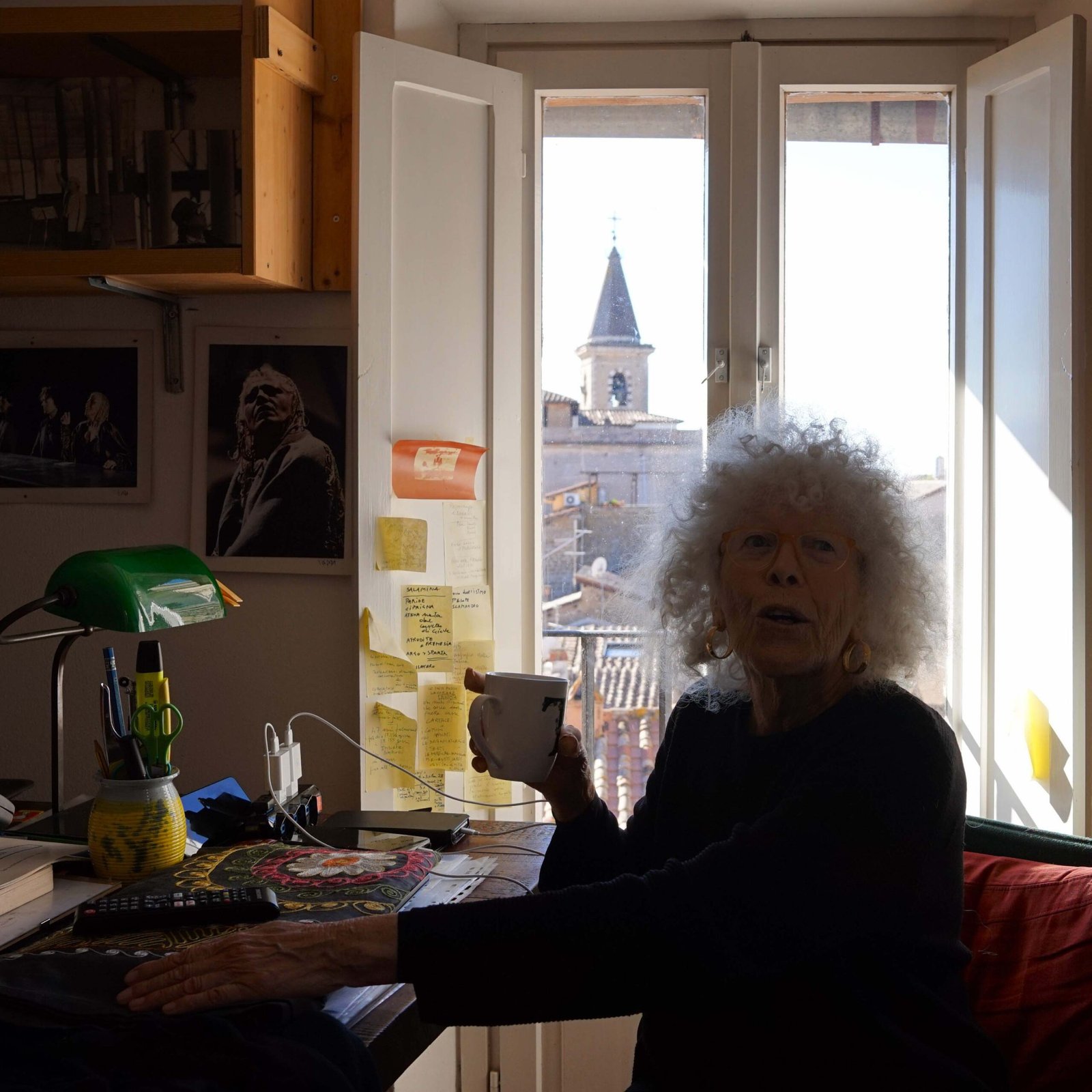
Interviewee: Tatò Carla
Interviewer: Orecchia Donatella Morganti Arianna
Orecchia Donatella Morganti Arianna
14 January 2024 – Carla Tatò’s house, Genazzano, Rome
Early 1980s
Keywords
- Ashley Robert
- Benjamin Walter
- Bennink Ham
- Branciaroli Franco
- Brega Piero
- Buren Daniel
- Castellitto Sergio
- Celant Germano
- Cinque Luigi
- Coen Massimo
- Colombaioni Willi
- Colombo Eugenio
- Conti Bicocchi Maria Gloria
- Coudray Michelle
- Cutarelli Dino
- de Sade Donatien-Alphonse-François
- Dell’Orso Edda
- Fabbri Marisa
- Fabro Luciano
- Fuchs Rudi
- Geremia Renato
- Gianelli Ida
- Gordon Peter
- Jonas Joan
- Kounellis Jannis
- Lerici Roberto
- Lessing Gotthold Ephraim
- Lucci Massimiliano
- Margiotto Domenico
- Marini Giovanna
- Marlowe Christopher
- Mengelberg Misha
- Michetti Ulderigo
- Morricone Ennio
- Neumann Andrés
- Nikkels Walter
- Nitsch Hermann
- Paolini Giulio
- Pellion Paolo
- Petroselli Luigi
- Piperno Elsa
- Piperno Giacomo
- Pirandello Luigi
- Prasca Giuliano
- Proietti Gigi
- Quartucci Carlo
- Quartucci Toto
- Saffo
- Scalchi Ada
- Schiaffini Giancarlo
- Schiavoni Piero
- Sudano Rino
- Tatò Carla
- ten Cate Ritzaert
- Van Tieghen David
- von Kleist Heinrich
- Wedekind Frank
- Weiner Lawrence
- 1793, da Parigi by Fuchs Rudi
- Borgatacamion by Camion (directed by Quartucci Carlo)
- Comédìe Italienne by Lerici Roberto, Paolini Giulio and Quartucci Carlo
- Didone by Lerici Roberto (directed by Quartucci Carlo)
- Dispositivo Scenico N. 1 by Buren Daniel
- Entro il regno dell’illuminazione by Weiner Lawrence
- Florville e Courval by de Sade François (directed by Quartucci Carlo)
- Funerale by Lerici Roberto and Kounellis Jannis (directed by Quartucci Carlo)
- Il fuoco che genera fumo. Il fumo che genera ballerina. Ballerina che genera galli by Kounellis Jannis
- Il Treno by Mengelberg Misha
- Histoire du soldat by Stravinskij Igor Fёdorovič (directed by Quartucci Carlo)
- L’ultimo spettacolo di Nora Helmer by Camion (directed by Quartucci Carlo)
- Pentesilea by von Kleist Heinrich (directed by Quartucci Carlo)
- Platea by Paolini Giulio and Quartucci Carlo
- Prologo by Paolini Giulio
- Robinson Crusoe mercante di York by Camion (directed byi Quartucci Carlo)
- Tamerlano Il Grande di Marlowe Christopher (directed by Quartucci Carlo)
- Un teatro musicale - Concerto scenico by Bennink Ham, Colombo Eugenio, Mengelberg Misha eìand Geremia Geremia
- Uscite by Kounellis Jannis and Quartucci Carlo
- Castello Colonna, Genazzano (RM)
- Erice
- Fabbrica Salzmann, Kassel
- Genazzano (RM)
- Hotel Cremona, Genazzano (RM)
- Mickery Theatre, Amsterdam
- Museum Fridericianum, Kassel
- Ninfeo del Bramante, Genazzano, (RM)
- Roma
- Compagnia Laboratorio Camion
- Progetto Genazzano
- Zattera di Babele
| DESCRIPTION | ||
| 00:00:00 – 00:10:46
The self-definition of Raft of Babel and the concept of the “happy tragedy”. |
Introduction and continuation of the dialogue with Carla Tatò on Genazzano Project.
D.O. Donatella Orecchia refers to Progetto Genazzano – Programma 1983, edited by Walter Nikkels and preserved in the Carlo Quartucci-Carla Tatò Archive, Museo Biblioteca dell’Attore, Genova. She discusses the self-definition of Raft of Babel (Zattera di Babele, 1982) and the need to distinguish it from the earlier Camion experience, which had until then served as the group’s primary production framework. C.T. Carla Tatò interprets this transition as a process of metamorphosis. She explains that the group’s arrival in Genazzano in 1980 was accompanied by the “baggage” of the previous trilogy of works. At the same time, a need emerged to understand the dynamics of the new context and to explore its original structure, including through the film Florville et Courval. Central to this phase was the desire to open the project to collaboration with other artists, including Germano Celant, Giulio Paolini, and Jannis Kounellis, all of whom had already participated in the Camion experience. D.O. Donatella Orecchia notes that the expression Raft of Babel already appeared in 1981. C.T. Carla Tatò explains that the term initially circulated informally within the group. She recalls the influence of early twentieth-century cabarets in shaping the performative “atmosphere” of the project. The spatial organization of the Colonna Wing, whose height exceeded twenty metres, was reimagined according to a vertical logic inspired by Elizabethan theatre, through the construction of a multi-level metal structure. At Jannis Kounellis’s suggestion, the audience was positioned laterally within a wooden structure, recalling the configuration of historical theatre models. Within this context, the concept of the “happy tragedy” emerged as a new scenic language capable of combining tragic elements with the vital dimension of theatrical action. Carlo Quartucci interpreted this configuration as a form of “dramaturgical village”, grounded in a contemporary reinterpretation of classical tragedy. “We used to say that we would create a happy tragedy… a happy tragedy, because the language of the stage is joyful. What we were discovering was a tragedy, but a happy one” (00:08:45-00:09:04). |
|
| 00:10:47 – 00:19:44
Giulio Paolini’s Prologue and the role of Ada Scalchi. |
C.T. Following a collaborative design process, Giulio Paolini’s Prologue was created in the Colonna Wing, incorporating projections of photographs of Genazzano taken by Paolo Pellion. Paolini reintroduced elements from earlier scenic experiences, including the curtain from Nora, and employed white fabric panels as projection surfaces. The Prologue is described as a performative device capable of expressing the identity of Genazzano itself.
At the same time, a musical dimension developed, symbolically transforming the castle into a “sound space”. A particularly significant site was the square between the Borgia Wing and the Colonna Wing, where an elevated structure was installed and musical performances – including those of the Albano marching band – took place. Tatò emphasizes Ada Scalchi’s role in supporting these initiatives and promoting the cultural transformation of the territory. |
|
| 00:19:45 – 00:24:12
From the Compagnia Laboratorio Camion to the Raft of Babel: Géricault and the plurality of languages. |
D.O. Donatella Orecchia returns to the transition, in 1982, from the Camion experience to the group’s self-definition as Raft of Babel.
C.T. Carla Tatò identifies the notion of “shipwrecked culture” as a key element of this transformation. The image of the Raft of Babel is associated with Théodore Géricault’s The Raft of the Medusa – already evoked in Robinson Crusoe – as a metaphor for arrival and survival. This image intersects with the coexistence of multiple artistic languages, generating a scenic configuration marked by expressive heterogeneity and by a sonic dimension emerging from the interaction between artists and space. “[…] a tumult, a storm of languages colliding and crashing into one another. A new sound emerged on its own, simply by inhabiting the space of the castle or by beginning to inhabit and construct the witches’ place, which was the Ninfeo del Bramante” (00:22:09-00:22:26). |
|
| 00:24:13 – 00:27:29
The artistic residency. |
D.O. Donatella Orecchia refers to the press release What Happens in Genazzano? (Press Release No. 6, 6 September 1983, preserved in the Carlo Quartucci-Carla Tatò Archive, Museo Biblioteca dell’Attore, Genova), introducing the topic of the artist residency and its temporal organization.
C.T. The Hotel Cremona accommodated the international artists, while other participants chose to remain for extended periods in order to become familiar with the local context. Tatò describes the creative process as alternating between a period of latency – likened to fallow land – and a phase of public emergence, closely connected to local rural cultural practices, such as the Vinaliae wine festival. |
|
| 00:27:30 – 00:34:24
Creative processes and the emergence of Genealogia. |
D.O. Donatella Orecchia further explores the development of the artistic programme, referring to projects such as Luciano Fabro’s Genealogia, Daniel Buren’s study of the town’s signage, and Misha Mengelberg’s musical activities, particularly the work Treno.
C.T. Carla Tatò distinguishes between different forms of residency: while some artists stayed in hotels, the core group – Carlo Quartucci, Carla Tatò, Jannis Kounellis, and Michelle Coudray – opted for direct immersion in the local community. The project Genealogia originated from an investigation of the town’s social structures through consultation of municipal registry archives and the public reading of the names of Genazzano’s inhabitants. The action unfolded along a territorial axis connecting Castello Colonna and the Ninfeo del Bramante, involving the community as a whole. The creative process integrated contributions from Carlo Quartucci, Carla Tatò, and Roberto Lerici, in dialogue with Luciano Fabro’s theoretical reflections on the relationship between time and theatre. In 1983, the artistic direction of the Genazzano Project was entrusted to Rudi Fuchs, marking a significant opening toward a broader European dimension. |
|
| 00:34:25 – 00:36:10
Misha Mengelberg’s Treno. |
C.T. Treno, composed by Misha Mengelberg with Han Bennink on percussion, is described as an ironic and fairy-tale-like musical narrative. “[…] it was a joke telling the story of a male mouse and a female mouse” (00:34:34-00:34:41).
Tatò explains that the work was staged in the Borgia Wing, whose articulated spatial configuration allowed for the integration of visual and performative elements. |
|
| 00:36:11 – 00:39:45
Hermann Nitsch at Genazzano.. |
D.O.Donatella Orecchia introduces Hermann Nitsch’s presence at Genazzano.
C.T. Carla Tatò describes Nitsch’s intervention as a ritual action characterized by a strong symbolic and material dimension. The artist selected a public space in which to perform an action involving an animal, thereby indirectly engaging the local community. The episode illustrates the intersection between contemporary artistic practices and rural culture, particularly in the relationship between humans and animals. Relational mediation – also fostered through convivial encounters – encouraged forms of interaction between artists and local inhabitants. “Hermann Nitsch would lock himself in a little tavern, where he drank and ate like a madman, holding meetings and proclaiming anathemas and principles – his own principles. Then he chose the square, the wall of the square, where Daniel [Buren] had also created his Sovrapposizione Colorate with the local children. We gave him complete freedom, and he chose that wall to hang his goat, which the local farmers had provided. They attended the ritual that Nitsch performed, pleased to witness this blood ritual. I must say it was extremely difficult because it was one thing to do it in his own castle in Austria, but quite another in a town like this… Yet imagine this: after the goat had been slaughtered, the farmers of Genazzano went up to Nitsch and asked, ‘May we eat it?’ Nitsch replied, ‘Of course’” (00:36:17-00:37:33). |
|
| 00:39:46 – 00:41:47
Lawrence Weiner’s intervention, Entro il regno dell’illuminazione. |
D.O. Donatella Orecchia refers to Lawrence Weiner’s work Entro il regno dell’illuminazione.
C.T. The intervention formed part of a broader sequence of artistic actions carried out in public space. Weiner created a bilingual wall inscription that was subsequently preserved through the initiative of members of the local community. The work is interpreted as a symbolic device of openness, capable of transforming the perceptual experience of the urban environment. |
|
| 00:41:48 – 00:46:36
The Ninfeo del Bramante and Daniel Buren’s Dispositivo scenico. |
D.O. Introduction of the transfer of activities to the Ninfeo del Bramante and the staging of Dispositivo scenico.
C.T. Carla Tatò emphasizes the dialogue between contemporary structure and historic architecture. Carlo Quartucci’s lighting design generated a perceptual dynamic based on the alternation between visibility and invisibility. The performance featured Elsa Piperno (dance) and Rino Sudano (voice), based on a text by Rudi Fuchs. The action is interpreted as a reflection on the crisis of European culture (“shipwrecked Europe”), conveyed through a synthesis of space, light, and performative presence. “And there was this problem of Europe dying – that was the point. So this Europe, represented within this space, with that magical use of light that only Carlo knew how to create, making spaces shine and come alive, was extraordinarily moving both theatrically and scenically” (00:45:38-00:46:15). |
|
| 00:46:37 – 00:48:55
The evolving conception of Zattera di Babele. |
A.M. Highlights the transition from the idea of Zattera di Babele to its concrete realization.
C.T. Carla Tatò describes a phase in which the project expanded beyond the local context, accompanied by a perceptual re-elaboration on the part of the community. The experience is interpreted as an exercise in collective imagination. |
|
| 00:48:56 – 00:56:40
Scenic adaptations and contexts: Funerale from Kassel to Genazzano. |
D.O. Analysis of the contextual and scenic transformations of Funerale between Kassel and Genazzano.
C.T. Carla Tatò explains how the change of context produced a redefinition of the work. In Genazzano, the action took the form of a reactivation of the natural space of the Ninfeo del Bramante, with strong participation from the local audience, who assumed an active role even in the scenic arrangement. |
|
| 00:56:41 – 01:00:15
Carla Tatò’s acting practice. |
C.T. The acting experience is described as a process of discovery shaped by the material conditions of the performance space (for example, the instability of the ground). Referring to Funerale, Tatò places particular emphasis on her relationship with Elsa Piperno, founded on the complementarity of voice and gesture. The absence of formal rehearsals underscores the centrality of situated performative action. “The two of us were so deeply inside one another that we simply couldn’t separate ourselves” (00:58:08-00:58:15). | |
| 01:00:16 – 01:12:39
Acting trajectory and socio-cultural context. |
D.O. Carla Tatò as an actress: from Didone to Funerale. Analysis of her artistic trajectory within Genazzano Project.
C.T. Carla Tatò relates her acting practice to Carlo Quartucci’s artistic direction and to the socio-cultural context of Genazzano (its spaces and institutions). The experience is characterized by a strong territorial rootedness and by a tension between artistic practice and civic reality. In the Roman suburbs, intervention took the form of proximity-based practices, involving direct access to private homes and operational mobility “with a suitcase”, whereas in Genazzano the relationship with the territory was also structured through participation in municipal council meetings. The minutes produced on those occasions were subsequently lost following a change in the local administration, an event Tatò interprets critically as evidence of the fragility of institutional memory: “This village has no history. We performed the last act of a living history” (01:04:54-01:05:02). The spatial context of the village, marked by conditions of decay and discontinuity, is described as an environment requiring operational immersion and imposing a concrete necessity for intervention and reactivation. Castello Colonna, in particular, appeared as a ruined structure, comparable to a field of rubble. Under these conditions, the urgency emerged to restore vitality to the site through artistic and scenic construction, understood also in a poetic sense. |
|
| 01:12:40 – 01:18:05
The voice in Didone. |
C.T. Vocal work is presented as a central element of Tatò’s acting research. She describes a transition from the scream to the whisper, understood as an expressive modulation capable of interacting with the acoustic properties of the performance space. | |
| 01:18:06 – 01:20:35
Relationship with space and spectator. |
D.O. Analysis of the relationship with space and with the audience in Genazzano.
C.T. The relationship with the spectator is not predetermined but emerges through situated interaction. The actress privileges a relationship with space and sonic elements within a complex performative dynamic. |
|
| 01:20:36 – 01:24:27
Costume and scenic identity in Didone. |
D.O. Didone‘s costume and the return to blonde hair.
C.T. Carla Tatò discusses her decision to return to her natural blonde hair colour: “On Camion, I chose to be brunette because black was beautiful, believe me” (01:21:14-01:21:21). The transformation of the actress’s personal appearance reflects a process of identity redefinition in relation to her previous artistic experiences. In Didone, the costume, designed together with Jannis Kounellis and made by Bice Minori, assumes both symbolic and material functions. |
|
| 01:24:28 – 01:30:44
The figure and costume in Funerale. |
D.O. The costume in Funerale.
C.T. The figure of the “woman in black” is interpreted as a liminal and testimonial presence. The costume, maintained across the different versions of the work (Kassel and Genazzano), contributes to the symbolic continuity of the character. |
|
| 01:30:45 – 01:38:05
The use of the microphone and the sonic dimension. |
D.O. Introduction of the use of the microphone on stage and its relationship to the sonic dimension.
C.T. The use of the microphone is linked to Quartucci’s conception of the relationship between theatre and cinema. The device amplifies the dimension of the “sonic close-up”, configuring the voice as a fragmented and highly focused element. End of interview. |
|
Interview Duration: 06:00:00 approximately
Registration Duration: 01:38:05
Format: wav
Type: Audio
Language: Italian
Subjects:
Original Document Placement:
- ICBSA, Via Caetani 32, 00186, Roma
- Museo Biblioteca dell’Attore, Via del Seminario 10, 16121, Genova
Usage and Rights:
Any use of the material different from listening (except short quotation) is not possible without the prior written consent of ECAD/ORMETE.
Interviews may only be reproduced with permission by ORMETE
Citation
Interview with Carla Tatò, conducted by Donatella Orecchia and Arianna Morganti, at Carla Tatò’s home in Genazzano (RM), on 14 January 2024, “Progetto Genazzano (1981–1984)”, Ormete Collection (ORMT-18f), consulted in URL:< https://patrimoniorale.ormete.net/interview/intervista-a-tatò-carla-3/>, (access date).
Relation: Bibliography: