
Interview with Piperno Elsa
ORMT-18ad
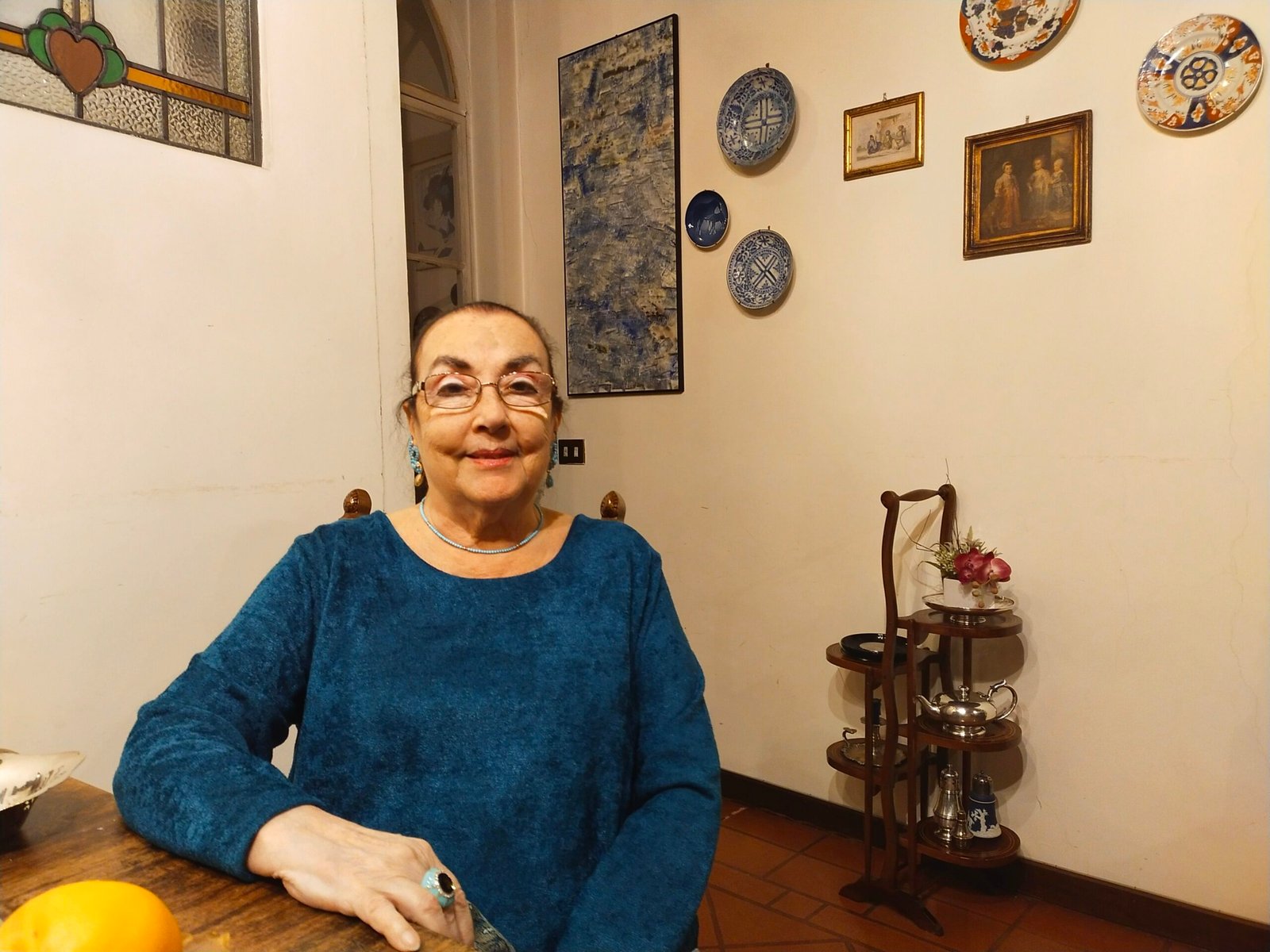
Interviewee: Piperno Elsa
Interviewer: Orecchia Donatella Morganti Arianna
Orecchia Donatella Morganti Arianna
27 November 2025 – Elsa Piperno’s house, Rione Monti, Rome
1970s – 1980s
Keywords
- Abramović Marina
- Benjamin Walter
- Bennink Ham
- Bentivoglio Leonetta
- Berlinguer Enrico
- Bertozzi Donatella
- Beuys Joseph
- Bonito Oliva Achille
- Branciaroli Franco
- Brega Marco
- Brega Piero
- Buren Daniel
- Bussotti Sylvano
- Celant Germano
- Cinque Luigi
- Coen Massimo
- Colombo Eugenio
- Conti Bicocchi Maria Gloria
- Coudray Michelle
- Cutarelli Dino
- de Sade Donatien-Alphonse-François
- Fabro Luciano
- Falsini Corrado
- Filippini Enrico
- Geremia Renato
- Géricault Théodore
- Gianelli Ida
- Graham Martha
- Kounellis Jannis
- Lerici Roberto
- Lessing Gotthold Ephraim
- Marini Giovanna
- Mengelberg Misha
- Michetti Ulderigo
- Neumann Andrés
- Nitsch Hermann
- Panepuccia Cesare
- Paolini Giulio
- Pellion Paolo
- Petroselli Luigi
- Piperno Giacomo
- Poe Amos
- Prasca Giuliano
- Proietti Gigi
- Quartucci Carlo
- Quartucci Toto
- Ruskaja Jia
- Scalchi Ada
- Tatò Antonio
- Tatò Carla
- Ulay
- Comédie Italianne by Paolini Giulio and Quartucci Carlo
- Funerale by Lerici Roberto and Kounellis Jannis (directed by Quartucci Carlo)
- Via del Gesù, Rome
- Teatro dell’Opera di Roma
- Ninfeo del Bramante, Genazzano (RM)
- Genazzano (RM)
- Castello Colonna, Genazzano (RM)
- AIAD (Associazione Italiana Attività di Danza)
- La Zattera di Babele
- TeatroDanza Contemporanea
| DESCRIPTION | ||
| 00:00:00 – 00:06:37
Elsa Piperno’s first entounter with Carlo Quartucci and Carla Tatò. |
D.O. During the introductory remarks, Donatella Orecchia invites Elsa Piperno to recall her first encounter with Carlo Quartucci and Carla Tatò.
E.P. The interviewee states that she does not clearly remember either the place or the circumstances of their first meeting, but notes that Quartucci was already familiar with her artistic practice and with the Dance Centre she had founded in Rome, on Via del Gesù, in 1972. Piperno then reconstructs the history of the Centre, describing it as the first Italian institution devoted to the Graham technique and American modern dance, conceived as a space for professional training, interdisciplinary experimentation, and research integrating dance, music, and voice. She also recalls the establishment of the TeatroDanza Contemporanea company and its tenth anniversary, celebrated at the Teatro dell’Opera di Roma between 1981 and 1982, situating her own artistic trajectory within the broader context of experimental performance practices in the 1970s. |
|
| 00:06:38 – 00:21:47
Artistic collaborations between Carlo Quartucci, Carla Tatò, and Elsa Piperno: Funerale. |
D.O. Donatella Orecchia directs the conversation towards Elsa Piperno’s artistic collaborations with Carlo Quartucci and Carla Tatò.
E.P. The interviewee first recalls her relationship with Massimo Coen and describes her Dance Centre as a meeting place for diverse artistic practices, metaphorically referring to it as a “harbour”. Reflecting on the origins of her relationship with Quartucci, she identifies their shared artistic collaborations as the starting point of their acquaintance. Focusing on Funerale, created within the framework of Progetto Genazzano, Piperno recalls Quartucci’s invitation to participate and the challenge of remaining on stage continuously for approximately fifty minutes. She describes the director’s working method as based on concise indications that left performers considerable freedom for personal elaboration. Within the performance, she embodied the spirit of the deceased prostitute, the only figure in constant movement throughout the scenic space and in continuous interaction with the other performers. She also recalls the presence of the horse as a highly evocative symbolic element and reflects on her stage relationship with Carla Tatò, whom she perceived as a complementary and contrasting figure: Tatò associated with speech and vocal expression, herself with movement and dance. The entire experience is described as an open-ended creative process in which each performance generated new scenic configurations. |
|
| 00:21:48 – 00:25:30
The Ninfeo del Bramante as scenic environment and the atmosphere of Genazzano Project. |
D.O. Donatella Orecchia asks Elsa Piperno to reflect on the extent to which the Bramante Nymphaeum influenced the staging of Funerale.
E.P. The interviewee acknowledges the evocative character of the site, while specifying that its impact was more evident in other works, such as Comédie Italienne, where the relationship with the performance environment was more direct and static. In Funerale, by contrast, the intensity of the action left little room for conscious reflection on the surrounding space. Piperno nevertheless emphasises the distinctive atmosphere that characterised Genazzano: a collective working environment sustained by mutual understanding and interpersonal exchange extending beyond the individual artistic projects. D.O. Donatella Orecchia invites Elsa Piperno to reflect on the exceptional nature of that experience. E.P. The interviewee confirms her perception of participating in a unique situation, animated by the simultaneous presence of multiple artistic activities, spaces, and protagonists. She also recalls Corrado Falsini, the photographer who began his career by documenting her work. |
|
| 00:25:31 – 00:37:58
Dance training and the discovery of Modern Dance. |
D.O. Donatella Orecchia invites Elsa Piperno to retrace her artistic training.
E.P. The interviewee reconstructs her childhood, beginning with her years in Africa, recalling how the body and dance constituted privileged forms of communication. Following her move to Italy, she enrolled at the Accademia Nazionale di Danza, from which she was expelled at the age of fourteen for reasons she attributes to antisemitic discrimination. She then recounts her period of employment in the tourism sector and her subsequent move to England, where she initially pursued classical dance before discovering the work of Martha Graham. She identifies the years spent in the United Kingdom during the 1960s as decisive for her artistic and professional development. |
|
| 00:37:59 – 00:49:24
Returning to Italy and the dissemination of the Graham Technique. |
D.O. Donatella Orecchia asks Elsa Piperno to reflect on her return to Italy.
E.P. The interviewee describes this period as particularly challenging due to the almost complete absence of spaces dedicated to modern dance and the Graham technique. She recalls the support provided by her husband’s family, particularly her sister-in-law Marina Piperno, a film producer, and describes the initiatives undertaken to introduce Martha Graham’s work to Italian audiences. Among these, she highlights the lecture demonstrations, educational events combining practical demonstrations with performance excerpts to present the technique. She also recalls her encounter with Francesca Astaldi, whom she identifies as an important figure in the promotion of dance in Italy, and emphasises how her Dance Centre quickly became a reference point for numerous Italian and international artists and students.
|
|
| 00:49:55 – 01:00:54
Rome between the 1970s and 1980s: cultural vitality and the institutional development of dance. |
D.O. Donatella Orecchia invites the interviewee to describe Rome’s cultural environment during the transition from the 1970s to the 1980s.
E.P. Elsa Piperno portrays a society marked by profound contradictions, shaped simultaneously by the Years of Lead and by an extraordinary degree of cultural vitality. She recalls Via del Gesù as a meeting place for different artistic languages and emphasises the energy of a generation driven by aspirations for social and cultural transformation. The conversation then turns to the institutional marginalisation of dance, which at the time lacked adequate representation within the principal professional organisations. Piperno recalls the establishment of the AIAD (Associazione Italiana Attività di Danza) and identifies the 1970s as a particularly fertile period for the development of contemporary dance in Italy. Among her former students, she mentions Donatella Bertozzi and Leonetta Bentivoglio. |
|
| 01:00:55 – 01:06:30
The question of Postmodernism. |
D.O. Donatella Orecchia introduces the emergence of postmodern poetics in theatre and the performing arts during the 1980s, asking Elsa Piperno to compare them with the artistic generation of Carlo Quartucci, Jannis Kounellis, and Giulio Paolini.
E.P. The witness observes that, in the field of dance, postmodernism became established primarily from the mid-1980s onward. She reaffirms the strong affinity she shared with Quartucci, grounded in a common commitment to artistic rigor and cultural responsibility. She expresses a critical view of certain postmodern tendencies, which she considers responsible for the progressive alienation of audiences. In contrast to these developments, she recalls her own commitment to promoting dance culture through educational activities, public discussions, and participation in events such as the Feste dell’Unità. |
|
| 01:06:31 – 01:10:42
Working with Carlo Quartucci. |
D.O. Returning to Elsa Piperno’s relationship with Carlo Quartucci, Donatella Orecchia asks what it meant to work with him and with the group that promoted Genazzano Project.
E.P. Elsa Piperno describes the experience as a significant source of both personal and professional enrichment. She particularly emphasizes Quartucci’s ability to foster genuine dialogue among different artistic disciplines, transforming interdisciplinarity into an actual working practice rather than a merely theoretical principle. She also recalls the atmosphere of mutual respect that characterized the collaboration and the absence of authoritarian attitudes on the director’s part, whose working method privileged cooperation and the enhancement of each artist’s individual contribution. |
|
| 01:10:43 – 01:19:36
Art and politics in Genazzano. |
D.O. Donatella Orecchia addresses the political dimension of Progetto Genazzano and the relationship between artistic practice and civic engagement.
E.P. Elsa Piperno confirms that she clearly perceived this political dimension, recalling that political commitment was an integral part of the cultural life of her dance center. D.O. Donatella Orecchia invites the witness to reflect on the relationship between Genazzano Project and the local political context, recalling Enrico Berlinguer’s visit to Genazzano. E.P. Elsa Piperno recalls Berlinguer’s visit. On that occasion, Carlo Quartucci invited her to stage choreographic interpretations of letters written by members of the Italian Resistance condemned to death. Although she does not precisely remember the location of the performance, she describes the experience as particularly intense and meaningful. |
|
| 01:19:37 – 01:27:18
Feminism, dance, and professional relationships. |
D.O. Donatella Orecchia introduces a discussion on the relationship between feminism and artistic practices in the 1970s and 1980s, asking whether Elsa Piperno perceived forms of sexism within theatre and dance during that period.
E.P. Elsa Piperno clearly distinguishes among the different professional contexts she experienced. She recalls encountering sexist attitudes within the theatrical environment associated with Carmelo Bene, but not within Genazzano Project. She explains that the principal challenges she faced were instead related to the marginal position of dance in comparison with other artistic disciplines, citing the disproportionate representation of music over dance within ministerial committees. Returning to Genazzano, she recalls cordial, though relatively distant, relationships with artists such as Jannis Kounellis and Giulio Paolini. |
|
| 01:27:19 – 01:32:29
The relationship with the community of Genazzano. |
D.O. In conclusion, Donatella Orecchia asks Elsa Piperno to reflect on the relationship she established with the inhabitants of Genazzano.
E.P. The witness primarily recalls the welcoming attitude and friendliness she encountered in everyday social spaces, such as restaurants and local gathering places. She does not, however, remember having developed sustained interactions with the local community, partly because the intensity of the artistic work often left her physically exhausted after rehearsals and performances. Returning once again to Carlo Quartucci’s working method, she emphasizes the balance he maintained between precise directorial guidance and the broad interpretative freedom granted to the artists involved. End of interview. |
|
Interview Duration: 03:00:00 approximately
Registration Duration: 01:38:54 (01:32:29)
Format: wav
Type: Audio
Language: Italiano
Subjects:
Original Document Placement:
- Museo Biblioteca dell’Attore, Via del Seminario 10, 16121, Genova
- ICBSA, Via Caetani 32, 00186, Roma
Usage and Rights:
Any use of the material different from listening (except short quotation) is not possible without the prior written consent of ECAD/ORMETE.
Interviews may only be reproduced with permission by ORMETE
Citation
Interview with Piperno Elsa, conducted by Donatella Orecchia and Arianna Morganti, at Elsa Piperno’s home, Rione Monti, Rome, on 27 November 2025, “Progetto Genazzano (1981–1984)”, Ormete Collection (ORMT-18ad), consulted in URL:<https://patrimoniorale.ormete.net/en/interview/interview-with-piperno-elsa/>, (access date).
Relation: Bibliography: