
Interview with Panepuccia Gino
ORMT-18u
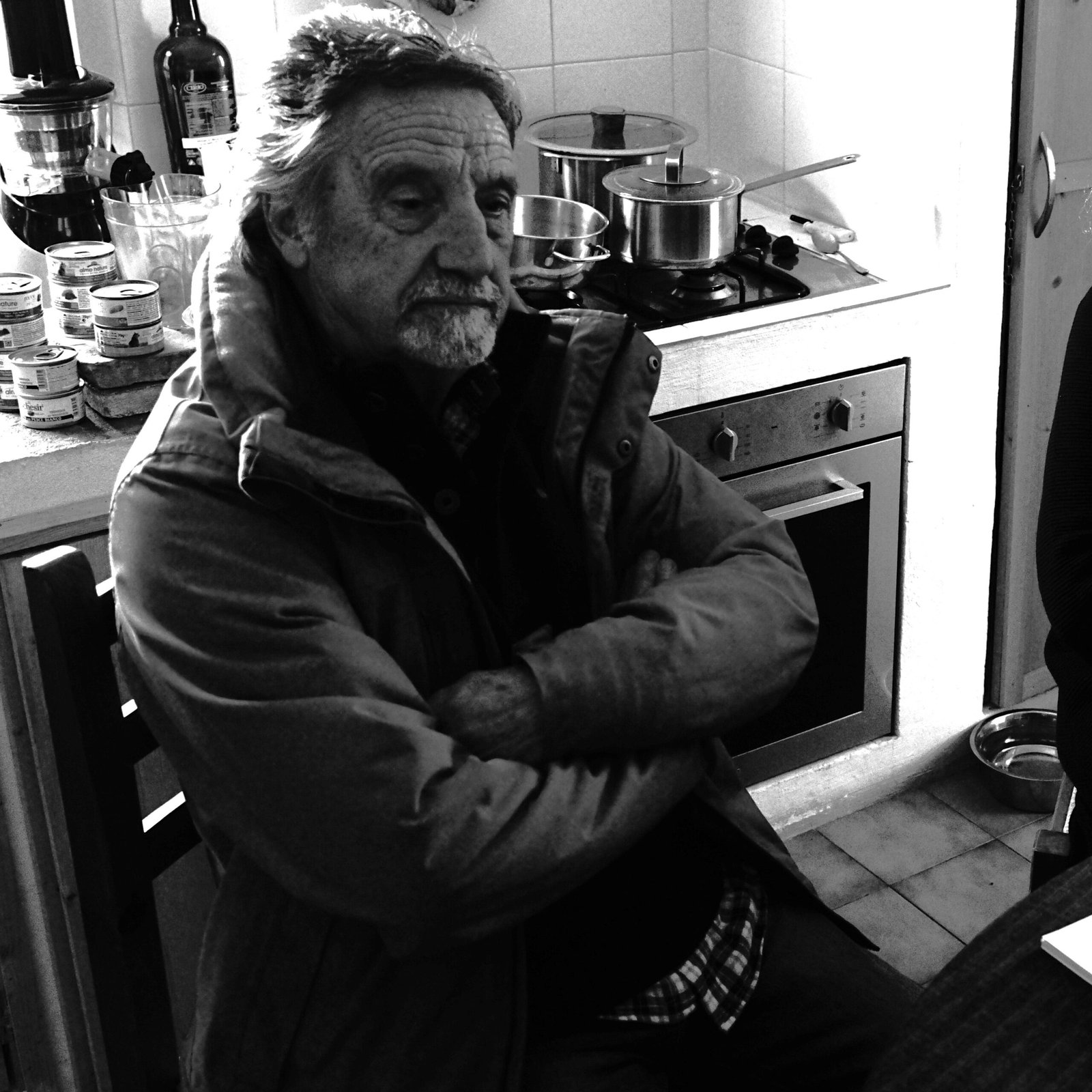
Interviewee: Panepuccia Gino
Interviewer: Orecchia Donatella Morganti Arianna
Orecchia Donatella Morganti Arianna
24 November 2024 – Carla Tatò’s house, Genazzano, Rome
Late 1970s – Early 1980s – Early 1990s
Keywords
- Abramović Marina
- Benjamin Walter
- Bennink Ham
- Branciaroli Franco
- Brega Piero
- Bussotti Sylvano
- Casamonica Enrico, detto “Ringo”
- Celant Germano
- Cinque Luigi
- Colombo Eugenio
- Conti Bicocchi Maria Gloria
- Coudray Michelle
- Cutarelli Dino
- de Sade Donatien-Alphonse-François
- Fabro Luciano
- Filippini Enrico
- Geremia Renato
- Géricault Théodore
- Gianelli Ida
- Kounellis Jannis
- Lerici Roberto
- Lessing Gotthold Ephraim
- Marini Giovanna
- Mengelberg Misha
- Michetti Ulderigo
- Neumann Andrés
- Panepuccia Cesare
- Paolini Giulio
- Pellion Paolo
- Petroselli Luigi
- Piperno Giacomo
- Pizzolante Marina
- Poe Amos
- Prasca Giuliano
- Proietti Gigi
- Quartucci Carlo
- Quartucci Toto
- Scalchi Ada
- Tatò Carla
- Genealogia by Fabro Luciano
- Uscite by Kounellis Jannis and Quartucci Carlo
- Castello Colonna, Genazzano (RM)
- Genazzano (RM)
- Ninfeo del Bramante, Genazzano (RM)
- Piazza Senile, Genazzano (RM)
| DESCRIPTION | ||
| 00:00:00 – 00:04:35
Early memories of Genazzano Project and the reactivation of Castello Colonna. |
Preliminary introductions.
D.O. Donatella Orecchia asks Gino Panepuccia to recall the arrival of Carlo Quartucci and Carla Tatò in Genazzano and to describe his own role during that period. G.P. Gino Panepuccia explains that he was not yet a member of the municipal administration, although he maintained a close relationship with Councillor for Culture Dino Cutarelli. He recalls welcoming Genazzano Project with enthusiasm, while questioning whether the town was fully prepared to grasp the significance of such an innovative initiative. He also remembers the favorable climate surrounding the restoration of local heritage sites, particularly Castello Colonna. D.O. She asks why Genazzano was not yet ready to embrace an experience of this kind. G.P. The witness argues that local cultural institutions lacked the necessary tools to engage fully with such an innovative project. Nevertheless, he emphasizes the importance of the restoration of Castello Colonna as an opportunity for the town’s cultural renewal. D.O. Donatella Orecchia points out that, following the arrival of Quartucci and Tatò, the castle once again became an inhabited and actively used space. G.P. He recalls the arrival of visitors from outside the town, a phenomenon previously limited to occasional holidaymakers. Personally drawn by the atmosphere of innovation that characterized those years, he attended several artistic events organized at the castle. D.O. She asks whether younger generations perceived the significance of what was taking place. G.P. He confirms the broad participation of young people and recalls the presence of students from Sapienza University of Rome. |
|
| 00:04:36 – 00:10:03
The Municipal Administration and community involvement. |
D.O. Donatella Orecchia asks whether any particular events or episodes have remained especially vivid in the witness’s memory.
G.P. He acknowledges the difficulty of reconstructing events that took place so long ago, noting that memories and chronological periods often overlap. D.O. She recalls the involvement of families and children in the project’s activities, noting that Panepuccia’s daughters had been born shortly before those years. G.P. He remembers the active participation of young people at the beginning of the project and reflects on the subsequent difficulties in ensuring political and generational continuity. D.O. She asks how the municipal administration was organized and how it related to the local community. G.P. He describes a period marked by strong civic participation, recalling municipal council meetings as important spaces for public discussion and collective information-sharing. C.T. Carla Tatò recalls being invited by Mayor Ulderigo Michetti and Councillor Dino Cutarelli to present the project publicly to the citizens. She emphasizes the continuous dialogue established with the local community and refers to Luciano Fabro’s Genealogia. G.P. He remembers the action and acknowledges its symbolic significance: initiatives such as Genealogia made local residents feel directly involved in the project. |
|
| 00:10:04 – 00:15:53
Peasant culture and Uscite. |
D.O. Donatella Orecchia asks whether, in the early 1980s, Genazzano was still characterized by a strong peasant culture and how the witness experienced that social context.
G.P. The witness explains that he was then employed as a driver for ATAC, Rome’s public transport company, and recalls the establishment of the Cantina Sociale of Genazzano. He observes that traditional agricultural culture was already undergoing a gradual process of transformation and decline. C.T. Carla Tatò refers to the experience of Vinaliae and shows a photograph of Jannis Kounellis’s glass curtain created for Uscite. G.P. Gino Panepuccia recognizes Sala Martino V in Castello Colonna, although he cannot precisely recall the performative context represented in the photograph. |
|
| 00:15:54 – 00:17:46
The Ninfeo del Bramante and selected artistic actions. |
D.O. Donatella Orecchia asks whether Gino Panepuccia retains any memories associated with the Ninfeo del Bramante.
C.T. Carla Tatò shows photographs of the Nymphaeum and Piazza del Senile, recalling some of the project’s principal artistic interventions. G.P. The witness remembers the inscription on the façade of a building in the town, referring to Lawrence Weiner’s Entro il Regno dell’Illuminazione. C.T. She also recalls Hermann Nitsch’s performance and the ritual sacrifice of a young goat, an episode that remained particularly vivid in the community’s collective memory. |
|
| 00:17:47 – 00:22:32
The Ninfeo del Bramante after Genazzano Project. |
G.P. Gino Panepuccia recalls several initiatives held at the Ninfeo del Bramante in the years following the conclusion of Quartucci and Tatò’s experience, particularly those organized by the Compagnia degli Arcieri during the 1990s.
D.O. Donatella Orecchia asks whether the Ninfeo continued to be used regularly. G.P. He believes that its use remained relatively limited. Besides Genazzano Project, he recalls only the activities of Sylvano Bussotti and the Compagnia degli Arcieri. He describes the 1980s as a period of remarkable social and cultural vitality, contrasting it with the gradual disappearance of longstanding community traditions such as the Infiorata.
|
|
| 00:22:33 – 00:24:06
The reception of Genazzano Project within the local community. |
D.O. Donatella Orecchia asks how local residents responded to the arrival of Italian and international artists, as well as to the increasing number of visitors from Rome.
G.P. The witness recalls that the experience was generally perceived as an interesting and stimulating novelty for the town. C.T. Carla Tatò emphasizes the contrast between the deteriorated condition of several of Genazzano’s symbolic sites when the company first arrived and the process of cultural revitalization that subsequently transformed both Castello Colonna and the Ninfeo del Bramante. |
|
| 00:24:07 – 00:25:34
The end of Genazzano Project and its legacy. |
A.M. Arianna Morganti asks whether the witness perceived any change following the conclusion of Carlo Quartucci and Carla Tatò’s experience in Genazzano.
G.P. Gino Panepuccia describes the end of the project as the beginning of a gradual decline in the town’s cultural life. He also recalls the subsequent attempt to revive this legacy promoted by Massimiliano Lucci. A.M. She asks whether Genazzano Project left a lasting mark on his own personal trajectory. G.P. He identifies the experience as an important stage in his growing engagement with politics and civic participation, developed through his relationship with Dino Cutarelli and through sustained involvement in collective public debate. Closing remarks. Acknowledgements and farewell. |
|
Interview Duration: 01:00:00 approximately
Registration Duration: 00:41:15 (00:25:34)
Format: wav
Type: Audio
Language: Italiano
Subjects:
Original Document Placement:
- ICBSA, Via Caetani 32, 00186, Roma
- Museo Biblioteca dell’Attore, Via del Seminario 10, 16121, Genova
Usage and Rights:
Any use of the material different from listening (except short quotation) is not possible without the prior written consent of ECAD/ORMETE.
Interviews may only be reproduced with permission by ORMETE
Citation
Interview with Panepuccia Gino, conducted by Donatella Orecchia and Arianna Morganti, at Carla Tatò’s house, Genazzano, Rome, on 14 April 2025, “Progetto Genazzano (1981–1984)”, Ormete Collection (ORMT-18u), consulted in URL: https://patrimoniorale.ormete.net/en/interview/interview-with-panepuccia-gino/>, (access date).
Relation: Bibliography: