
Interview with Bistolfi Marina
ORMT-18ab
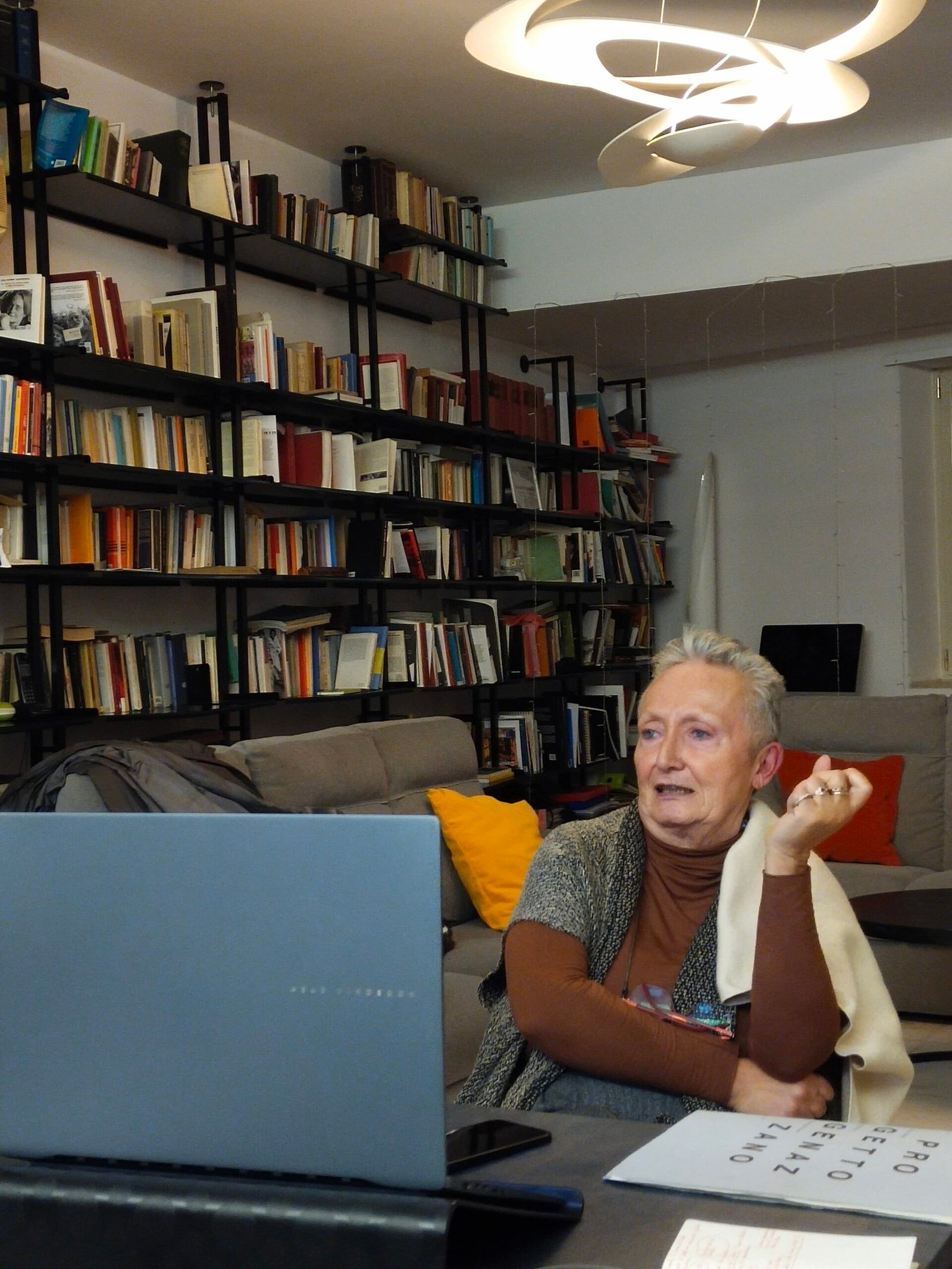
Interviewee: Bistolfi Marina
Interviewer: Orecchia Donatella Morganti Arianna
Orecchia Donatella Morganti Arianna
10 November 2025 – Donatella Orecchia’s house, Roma
Early 1980s
Keywords
- Ashley Robert
- Bartolucci Giuseppe
- Bene Carmelo
- Benjamin Walter
- Bennink Ham
- Berlinguer Enrico
- Branciaroli Franco
- Brega Piero
- Buren Daniel
- Castellitto Sergio
- Celant Germano
- Cinque Luigi
- Coen Massimo
- Colombaioni Willi
- Colombo Eugenio
- Conti Bicocchi Maria Gloria
- Coudray Michelle
- Cutarelli Dino
- de Sade Donatien-Alphonse-François
- Dell’Orso Edda
- Fabbri Marisa
- Fabro Luciano
- Fadini Edoardo
- Fuchs Rudi
- Geremia Renato
- Gianelli Ida
- Gordon Peter
- Jonas Joan
- Kounellis Jannis
- Lerici Roberto
- Lessing Gotthold Ephraim
- Lyotard Jean-Francois
- Lucci Massimiliano
- Mango Achille
- Margiotto Domenico
- Marini Giovanna
- Marlowe Christopher
- Mengelberg Misha
- Menna Filiberto
- Michetti Ulderigo
- Morricone Ennio
- Neumann Andrés
- Nikkels Walter
- Nitsch Hermann
- Paolini Giulio
- Pellion Paolo
- Petroselli Luigi
- Piperno Elsa
- Piperno Giacomo
- Pirandello Luigi
- Prasca Giuliano
- Proietti Gigi
- Quartucci Carlo
- Quartucci Toto
- Saffo
- Scalchi Ada
- Schiaffini Giancarlo
- Schiavoni Piero
- Sudano Rino
- Tatò Antonio
- Tatò Carla
- ten Cate Ritzaert
- Van Tieghen David
- von Kleist Heinrich
- Wedekind Frank
- Weiner Lawrence
- 1793, da Parigi by Fuchs Rudi
- Borgatacamion by Camion (directed by Quartucci Carlo)
- Comédìe Italienne by Lerici Roberto, Paolini Giulio and Quartucci Carlo
- Didone by Lerici Roberto (directed by Quartucci Carlo)
- Florville and Courval by de Sade François (directed by Quartucci Carlo)
- Funerale by Lerici Roberto and Kounellis Jannis (directed by Quartucci Carlo)
- Il fuoco che genera fumo. Il fumo che genera ballerina. Ballerina che genera galli by Kounellis Jannis
- Histoire du soldat by Stravinskij Igor Fёdorovič (directed by Quartucci Carlo)
- L’ultimo spettacolo di Nora Helmer di Camion (directed by Quartucci Carlo)
- Pentesilea by von Kleist Heinrich (directed by Quartucci Carlo)
- Platea by Paolini Giulio and Quartucci Carlo
- Prologo by Paolini Giulio
- Robinson Crusoe mercante di York by Camion (directed by Quartucci Carlo)
- Scene di Periferia by Quartucci Carlo
- Tamerlano Il Grande di Marlowe Christopher (directed by Quartucci Carlo)
- Un teatro musicale - Concerto scenico by Bennink Ham, Colombo Eugenio, Mengelberg Misha and Geremia Geremia
- Uscite by Kounellis Jannis and Quartucci Carlo
- Aranciera di San Sisto Vecchio, Roma
- Castello Colonna, Genazzano (RM)
- Erice
- Genazzano (RM)
- Genova
- Ninfeo del Bramante, Genazzano, (RM)
- Roma
- Compagnia Laboratorio di Camion
- Progetto Genazzano
- Zattera di Babele
| DESCRIPTION | ||
| 00:00:00 – 00:05:28
Marina Bistolfi’s first encounter with Carlo Quartucci and Carla Tatò. |
Preliminary introductions.
D.O. Donatella Orecchia invites Marina Bistolfi to recall her first encounter with Carlo Quartucci and Carla Tatò. M.B. Marina Bistolfi describes the encounter as a fortuitous episode that marked the beginning of her collaboration with the group. She recalls attending the second edition of the course for theatre organizers promoted by ETI and directed by Fulvio Fo (1981–1982), alongside a period of study in Berlin. She remembers that, in May 1982, the concluding meeting of the course took place in Genazzano, shortly after the second edition of Progetto Genazzano. Carlo Quartucci and Carla Tatò accompanied the participants in exploring Castello Colonna and the town, introducing them to the principles underlying the artistic project. On that occasion, the need arose for someone with German-language skills to support the group’s participation in Documenta 7, leading to the beginning of Marina Bistolfi’s collaboration with the group. D.O. Donatella Orecchia asks what first impression Carlo Quartucci and Carla Tatò made on her, even before she had seen their artistic work. M.B. Marina Bistolfi recalls both as highly charismatic storytellers, capable of conveying their project and artistic imagination with great force. |
|
| 00:05:29 – 00:10:28
Marina Bistolfi’s role at Documenta 7, Kassel. |
D.O. Donatella Orecchia asks what role Marina Bistolfi played during Documenta 7, Kassel.
M.B. Marina Bistolfi reconstructs her involvement in the project as an assistant and translator, explaining that the precise terms of the collaboration were defined progressively. She recalls the presence in Kassel of Carlo Quartucci, Carla Tatò, Roberto Lerici, and Jannis Kounellis, within the artistic direction of Rudi Fuchs, whose approach was open to collaboration with figures such as Germano Celant and Walter Nikkels, who would later be responsible for the visual identity of Genazzano Project. She emphasizes that the work was then coordinated by Ida Giannelli, a collaborator of Carlo Quartucci and Carla Tatò who did not speak German; this circumstance made her involvement as a linguistic mediator necessary. D.O. Donatella Orecchia asks how Marina Bistolfi perceived Carlo Quartucci and Carla Tatò’s working methods. M.B. Marina Bistolfi emphasizes that Documenta was, alongside the Venice Biennale, one of the major international events devoted to contemporary art. She recalls that Didone was primarily received as a performance work, while Platea was characterized by a scenic dispositif that redefined the relationship between stage and spectator: the space traditionally reserved for the audience was covered with white sheets, and spectators were invited to step directly onto the stage. |
|
| 00:10:29 – 00:13:10
Rudi Fuchs and his collaboration with Carlo Quartucci and Carla Tatò in Genazzano Project. |
D.O. Donatella Orecchia asks what, in Marina Bistolfi’s view, motivated Rudi Fuchs’s interest in the work of Carlo Quartucci and Carla Tatò.
M.B. Marina Bistolfi identifies the mediation of Jannis Kounellis and Germano Celant as the principal link between Carlo Quartucci and the international milieu of Documenta. She distinguishes Germano Celant’s role, primarily oriented toward cultural strategies and the art system, from that of Rudi Fuchs, who was more interested in the poetic dimension and creative processes, alongside Walter Nikkels’s contribution to the project at the level of visual identity. According to the interviewee, Carlo Quartucci consistently prioritized an autonomous artistic practice independent of the logic of the market. |
|
| 00:13:11 – 00:22:28
Funerale at Documenta 7. |
D.O. Donatella Orecchia introduces the staging of Funerale in the concluding context of Documenta 7.
M.B. Marina Bistolfi describes Funerale as one of Carlo Quartucci’s most significant works. She recalls the decision to stage the performance inside a disused former textile factory, emphasizing the organizational complexity of the production. She recalls Jannis Kounellis’s preparatory work, involving the continuous development of project drawings, as well as the logistical difficulties associated with transporting horses into the industrial spaces. D.O. Donatella Orecchia asks which elements, in her view, made Funerale such a particularly significant experience. M.B. Marina Bistolfi attributes the work’s significance to the processual nature of its construction, which she experienced directly from within the working group. She emphasizes the role of Roberto Lerici’s dramaturgy, the construction of the stage image, and the collaboration between Italian and German artists. She underlines how Funerale was progressively shaped through continuous exchange among musicians, performers, and visual artists, incorporating references to Frank Wedekind and to Greek lyric poetry, particularly Sappho. |
|
| 00:22:29 – 00:26:39
Carla Tatò in Funerale. |
D.O. Donatella Orecchia explores Carla Tatò’s role and her relationship with the other performers on stage.
M.B. Marina Bistolfi describes Carla Tatò as a central figure in the performance, emphasizing the deep understanding she developed with the group of musicians – including Piero Brega, Giancarlo Schiaffini, Massimo Coen, and Eugenio Colombo – already established through their previous experiences with Zattera di Babele. The interviewee also recalls the support received from Rudi Fuchs’s assistant during the complex organizational phases of Documenta 7. |
|
| 00:26:40 – 00:32:19
The staging of Funerale: from Kassel to Genazzano. |
D.O. Donatella Orecchia invites Marina Bistolfi to reflect on the transfer of Funerale from Kassel to the Ninfeo del Bramante in Genazzano and on its encounter with a new spatial context and a different audience.
M.B. Marina Bistolfi emphasizes the role played by Jannis Kounellis in reconfiguring the Ninfeo del Bramante as a scenic dispositif. She highlights how the gradual shift of activities from Castello Colonna toward Genazzano’s urban and monumental spaces expanded the project’s scope of action. She interprets the different versions of Funerale as processes of site-specific rewriting, in which each new context generated different compositional possibilities. |
|
| 00:32:20 – 00:35:49
Carlo Quartucci and Jannis Kounellis in Genazzano. |
D.O. Donatella Orecchia asks how Marina Bistolfi observed the collaborative relationship between Carlo Quartucci and Jannis Kounellis during Genazzano Project.
M.B. Marina Bistolfi explains that she remained outside the personal dimension of their relationship, focusing primarily on international relations and linguistic mediation. From an artistic perspective, however, she describes a collaboration based on a substantial balance between the two, with both artists contributing equally to the development of the works. |
|
| 00:35:50 – 00:42:38
Marina Bistolfi’s role in Genazzano Project and the participation of international artists. |
D.O. Donatella Orecchia asks what organizational role Marina Bistolfi played within Zattera di Babele and whether she was responsible for relations with institutions and foreign artists.
M.B. Marina Bistolfi explains that artistic and political relations were primarily managed by Carlo Quartucci and Carla Tatò, the latter being particularly involved in institutional relations. Her own contribution focused mainly on communication and coordination with international artists. D.O. Donatella Orecchia asks whether the presence of foreign artists in the 1983 edition of Genazzano Project was primarily due to Rudi Fuchs. M.B. Marina Bistolfi emphasizes the shared nature of the curatorial decisions, highlighting Rudi Fuchs’s openness to collaboration. She describes the presence of international artists as a harmonious process of coexistence and exchange, in which participation and the sharing of the experience took precedence over complete mutual understanding. |
|
| 00:42:39 – 00:45:42
Hermann Nitsch in Genazzano. |
D.O. Donatella Orecchia introduces Hermann Nitsch’s performance, remembered by the inhabitants of Genazzano as one of the project’s most significant actions, and asks how Marina Bistolfi perceived it.
M.B. Marina Bistolfi distinguishes the intervention carried out in Genazzano from the better-known actions of the Orgien Mysterien Theater, emphasizing its more restrained character. She recalls the creation of a cloth painted with goat’s blood, temporarily stored in plastic containers inside the hotel refrigerator. She emphasizes that the performance aroused curiosity and attracted broad participation, involving both local residents and the numerous visitors who came to Genazzano. |
|
| 00:45:43 – 01:02:29
The construction of testimonial memory and Marina Bistolfi’s time in Genazzano. |
A.M. Arianna Morganti returns to Hermann Nitsch’s action, asking Marina Bistolfi to clarify some recurring elements in the collective memory of the event.
M.B. Marina Bistolfi specifies that the performance took place in Piazza del Senile and refutes the recurring account of a kid being slaughtered during the action. She explains that the intervention involved only the use of containers filled with animal blood, while the slaughter had taken place previously in an authorized abattoir. She interprets this discrepancy as a process of myth-making that developed through the oral transmission of the event. A.M. Arianna Morganti asks how much time Marina Bistolfi actually spent in Genazzano, distinguishing between the period of the festival itself and the preparatory phase. M.B. Marina Bistolfi recalls dividing her time between Rome and Genazzano, primarily in connection with organizational activities and relations with foreign artists, which were largely conducted through intensive correspondence and telephone communication. Reading and discussion of selected pages from the 1983 Genazzano Project catalogue. |
|
| 01:02:30 – 01:07:48
Communication with the local community and the hospitality offered to artists. |
D.O. Donatella Orecchia asks what happened to the materials produced for Genazzano Project, and whether they were intended exclusively for internal use or also for the press and public communication.
M.B. Marina Bistolfi distinguishes between working materials and dissemination tools, recalling the production of press releases and information sheets distributed to the public on the occasion of individual performances and actions, in an attempt to foster communication with the local community. D.O. Donatella Orecchia further explores the arrangements for foreign artists staying in Genazzano. M.B. Marina Bistolfi explains that the duration of their residencies varied according to the time required to prepare the works and performative actions. D.O. Donatella Orecchia asks who was responsible for welcoming the artists and integrating them into the working context in Genazzano. M.B. Marina Bistolfi recalls that this role was primarily carried out by Carla Tatò, although the arrangements varied depending on the artists involved. Some had already participated in previous editions of the project, while others had been met during Documenta 7. She identifies hospitality as one of the defining elements of Carlo Quartucci and Carla Tatò’s working method. |
|
| 01:07:49 – 01:11:33
The encounter between different artistic poetics and practices. |
D.O. Donatella Orecchia invites Marina Bistolfi to reflect on the coexistence of artists from different disciplines and backgrounds.
M.B. Marina Bistolfi emphasizes that participation in the project was the result of a conscious choice. The artists shared intellectual curiosity, openness to dialogue, and an interest in interdisciplinary working practices. D.O. Donatella Orecchia asks whether this collaborative dimension was also perceptible from within the creative process. M.B. Marina Bistolfi confirms the existence of an atmosphere characterized by continuous dialogue, collaboration, and the sharing of everyday life. Hospitality translated into living together, joint site visits, and a constant exchange of ideas. |
|
| 01:11:34 – 01:14:52
Carlo Quartucci’s cultural background and project-oriented intuition. |
D.O. Donatella Orecchia recalls a reflection that emerged in the interview with Luigi Cinque concerning Carlo Quartucci’s intuitive capacity.
M.B. Marina Bistolfi attributes this quality to a solid cultural background and a profound knowledge of theatre and contemporary arts. She also specifies that Luigi Cinque was primarily involved in the organizational and musical phases of the productions, rather than in the processes of scenic conception. |
|
| 01:14:53 – 01:18:08
Giulio Paolini and Jannis Kounellis: two different approaches to artistic conception. |
D.O. Donatella Orecchia asks whether the site-specific character of Genazzano Project was particularly compatible with Giulio Paolini’s artistic research.
M.B. Marina Bistolfi distinguishes Carlo Quartucci’s relationship with Giulio Paolini from the one he established with Jannis Kounellis. While expressing great esteem for Paolini, she believes that the experimental dimension of Genazzano was more closely aligned with Kounellis’s research, while identifying a more significant presence of Paolini in the work developed in Kassel and, subsequently, in the experience of Erice. |
|
| 01:18:09 – 01:22:20
Rudi Fuchs and Daniel Buren’s Dispositivo Scenico. |
D.O. Donatella Orecchia introduces Rudi Fuchs’s presence in Genazzano.
M.B. Marina Bistolfi recalls that Rudi Fuchs participated in the third edition of Genazzano Project (1983), while his presence would become more continuous in the subsequent experiences in Erice. She also recalls the text 1793 da Parigi, incorporated into Dispositivo Scenico, designed by Daniel Buren. D.O. Donatella Orecchia observes that, unlike the inscriptions created with Daniel Buren throughout the town, Dispositivo Scenico does not frequently emerge in the memories of Genazzano’s inhabitants M.B. Marina Bistolfi interprets Dispositivo Scenico as an element serving the performative actions, analogous to the curtain made of glasses conceived by Jannis Kounellis. She emphasizes its character as a spatial dispositif, whose effectiveness depended on its interaction with the scenic events hosted by the Ninfeo del Bramante, a site that attracted a significant audience. |
|
| 01:22:21 – 01:27:26
The distance between the contemporary theatre system and the experience of Genazzano Project. |
D.O. Donatella Orecchia invites Marina Bistolfi to compare the contemporary context with the one in which Genazzano Project emerged.
M.B. Marina Bistolfi highlights a progressive transformation of the cultural system, recalling the years of Genazzano Project as a period characterized by strong institutional support, substantial availability of resources, and favorable conditions for interdisciplinary experimentation. She emphasizes the political significance of the initiative, which was also made possible by the support of the municipal administration led by Mayor Ulderigo Michetti. |
|
| 01:27:27 – 01:32:19
The conclusion of Genazzano Project. |
D.O. Donatella Orecchia asks how Marina Bistolfi experienced the conclusion of Genazzano Project.
M.B. Marina Bistolfi recalls that she participated exclusively in the 1983 edition and interprets the subsequent transition from Kassel to Genazzano and then to Erice as a single, continuously evolving project experience, capable of transforming itself by adapting to different contexts. |
|
| 01:32:19 – 01:44:04
The professional legacy of working with Carlo Quartucci and Carla Tatò. |
D.O. Donatella Orecchia asks how long Marina Bistolfi continued to collaborate with Carlo Quartucci and Carla Tatò.
M.B. Marina Bistolfi places the end of the collaboration at the beginning of the 1990s. D.O. Donatella Orecchia asks what she learned from that experience. M.B. Marina Bistolfi describes the collaboration as an unrepeatable professional and human experience, fully consistent with her own inclination toward interdisciplinary artistic contexts. She emphasizes how the relationship established with Carlo Quartucci and Carla Tatò acquired both a professional and personal dimension, contributing to the development of her network of relationships within the arts. D.O. Donatella Orecchia asks whether Carlo Quartucci and Carla Tatò succeeded in reconciling artistic freedom with institutional compromise. M.B. Marina Bistolfi believes that this balance was never fully achieved and, by contrast, refers to the so-called “Peter Stein model”, based on alternating institutional productions with independent artistic research as a strategy for economic sustainability. |
|
| 01:44:05 – 01:47:56
Working with Carlo Quartucci and Carla Tatò as a space for experimentation. |
D.O. Donatella Orecchia observes that numerous collaborators have described working with Carlo Quartucci and Carla Tatò as a space of particular creative freedom.
M.B. Marina Bistolfi confirms this interpretation, emphasizing the innovative character of their working method and their ability to introduce into theatre practices of hospitality and collaboration associated with the visual arts, which were still relatively uncommon in the theatrical context of the time. |
|
| 01:47:57 – 01:51:27
The critical reception of Genazzano Project. |
D.O. Donatella Orecchia recalls the presence of theatre criticism in accounts of the activities of Genazzano Project.
M.B. Marina Bistolfi attributes the limited critical reception to the interdisciplinary nature of the project, which she considers difficult to accommodate within the traditional interpretive categories of theatre criticism. |
|
| 01:51:28 – 01:58:25
Enrico Berlinguer’s visit and the presence of Antonio Tatò. |
D.O. Donatella Orecchia invites Marina Bistolfi to summarize Genazzano Project through a significant image.
M.B. Marina Bistolfi recalls Enrico Berlinguer’s visit to the 1983 edition, accompanied by Antonio Tatò, identifying it as one of the most emblematic images of the experience. D.O. Donatella Orecchia asks whether Antonio Tatò’s presence was also perceived as a significant element within the project. M.B. Marina Bistolfi confirms that Antonio Tatò was a constant and well-known presence within the context of Progetto Genazzano. End of the interview. |
|
Interview Duration: 04:00:00 approximately
Registration Duration: 02:08:00 (01:58:25)
Format: mp3
Type: Audio
Language: Italiano
Subjects:
Original Document Placement:
- Museo Biblioteca dell’Attore
- ICBSA, Via Caetani 32, 00186, Roma
Usage and Rights:
Any use of the material different from listening (except short quotation) is not possible without the prior written consent of ECAD/ORMETE.
Interviews may only be reproduced with permission by ORMETE
Citation
Interview with Bistolfi Marina, conducted by Donatella Orecchia and Arianna Morganti, at Donatella Orecchia’s home, Rome, on 10 November 2025, “Progetto Genazzano (1981–1984)”, Ormete Collection (ORMT-18ab), consulted in URL:< https://patrimoniorale.ormete.net/en/interview/interview-with-bistolfi-marina/ >, (access date).
Relation: Bibliography: