
Interview with Tatò Carla
ORMT-18g
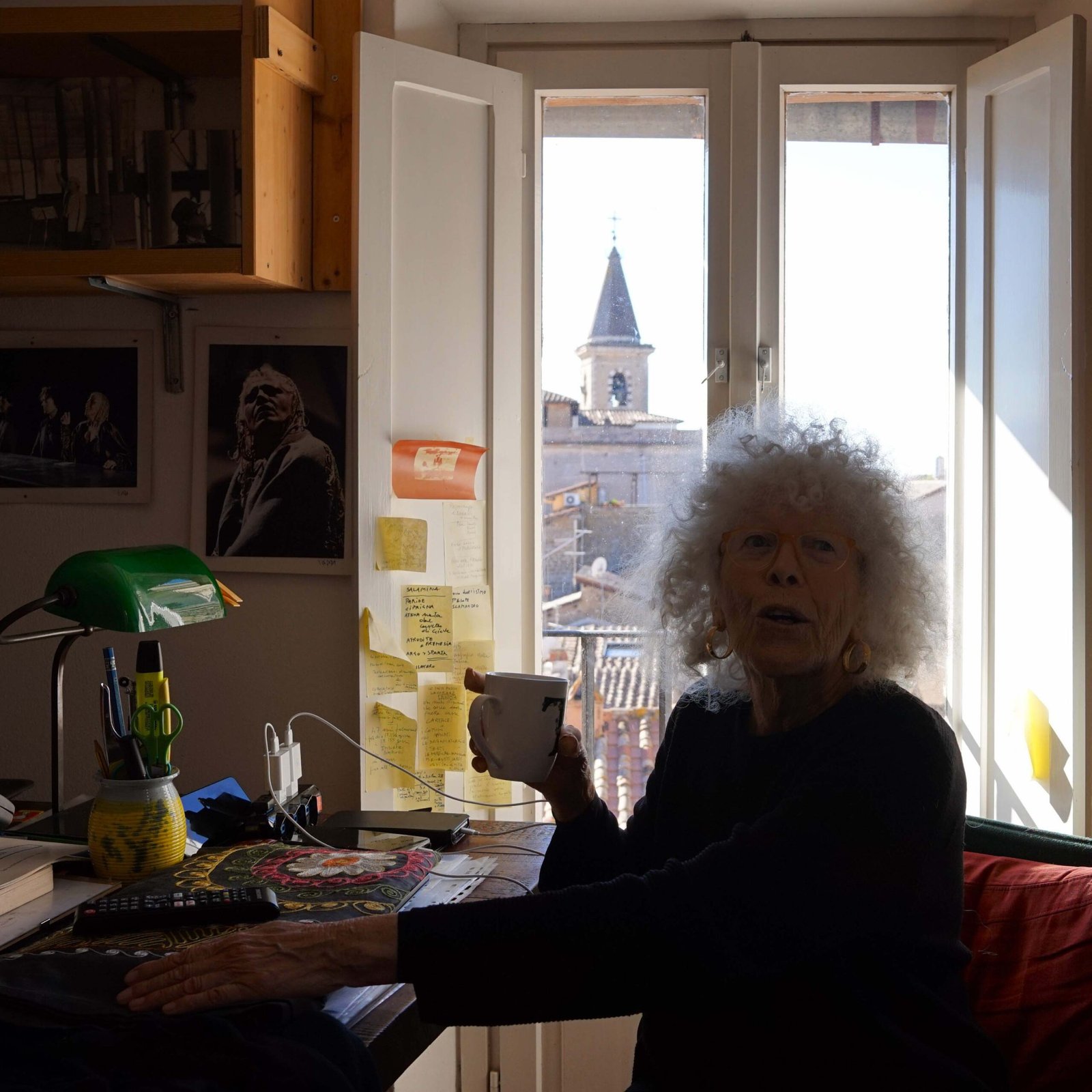
Interviewee: Tatò Carla
Interviewer: Orecchia Donatella Morganti Arianna
Orecchia Donatella Morganti Arianna
21 January 2024 – Carla Tatò’s house, Genazzano, Rome
Early 1980s
Keywords
- Ashley Robert
- Benjamin Walter
- Bennink Ham
- Branciaroli Franco
- Brega Piero
- Buren Daniel
- Castellitto Sergio
- Celant Germano
- Cinque Luigi
- Coen Massimo
- Colombaioni Willi
- Colombo Eugenio
- Conti Bicocchi Maria Gloria
- Coudray Michelle
- Cutarelli Dino
- de Sade Donatien-Alphonse-François
- Dell’Orso Edda
- Fabbri Marisa
- Fabro Luciano
- Fuchs Rudi
- Geremia Renato
- Gianelli Ida
- Gordon Peter
- Jonas Joan
- Kounellis Jannis
- Lerici Roberto
- Lessing Gotthold Ephraim
- Lucci Massimiliano
- Margiotto Domenico
- Marini Giovanna
- Marlowe Christopher
- Mengelberg Misha
- Michetti Ulderigo
- Morricone Ennio
- Neumann Andrés
- Nikkels Walter
- Nitsch Hermann
- Paolini Giulio
- Pellion Paolo
- Petroselli Luigi
- Piperno Elsa
- Piperno Giacomo
- Pirandello Luigi
- Prasca Giuliano
- Proietti Gigi
- Quartucci Carlo
- Quartucci Toto
- Saffo
- Scalchi Ada
- Schiaffini Giancarlo
- Schiavoni Piero
- Sudano Rino
- Tatò Carla
- ten Cate Ritzaert
- Van Tieghen David
- von Kleist Heinrich
- Wedekind Frank
- Weiner Lawrence
- 1793, da Parigi by Fuchs Rudi
- Borgatacamion by Camion (directed by Quartucci Carlo)
- Comédìe Italienne by Lerici Roberto, Paolini Giulio and Quartucci Carlo
- Didone by Lerici Roberto (directed by Quartucci Carlo)
- Dispositivo Scenico N. 1 by Buren Daniel
- Florville e Courval by de Sade François (directed by Quartucci Carlo)
- Funerale by Lerici Roberto and Kounellis Jannis (directed by Quartucci Carlo)
- Il fuoco che genera fumo. Il fumo che genera ballerina. Ballerina che genera galli by Kounellis Jannis
- Il Treno by Mengelberg Misha
- Histoire du soldat by Stravinskij Igor Fёdorovič (directed by Quartucci Carlo)
- L’ultimo spettacolo di Nora Helmer by Camion (directed by Quartucci Carlo)
- Pentesilea by von Kleist Heinrich (directed by Quartucci Carlo)
- Platea by Paolini Giulio and Quartucci Carlo
- Prologo by Paolini Giulio
- Robinson Crusoe mercante di York by Camion (directed by Quartucci Carlo)
- Tamerlano Il Grande by Marlowe Christopher (directed byQuartucci Carlo)
- Un teatro musicale - Concerto scenico by Bennink Ham, Colombo Eugenio, Mengelberg Misha NS Geremia Geremia
- Uscite by Kounellis Jannis and Quartucci Carlo
- Castello Colonna, Genazzano (RM)
- Erice
- Fabbrica Salzmann, Kassel
- Genazzano (RM)
- Mickery Theatre, Amsterdam
- Museum Fridericianum, Kassel
- Ninfeo del Bramante, Genazzano, (RM)
- Rome
- Compagnia Laboratorio di Camion
- Genazzano Project
- Zattera di Babele
| DESCRIPTION | ||
| 00:00:00 – 00:06:44
Video testimony of Funerale. |
Viewing of the opening sequence of the scenic action Funerale. | |
| 00:06:45 – 00:10:32
Funerale: scenic and dramaturgical dimensions. |
Continuation of the interview and initial reflections following the viewing.
D.O. While watching selected excerpts from Funerale at the Ninfeo del Bramante, Donatella Orecchia asks Carla Tatò about her reaction to seeing herself and revisiting her work after many years. C.T. Carla Tatò recalls the arrival of the carriage and the horses, together with their scenic positioning, interpreting this moment as the discovery of a new compositional possibility. The dramaturgical tension is attributed to the polarity between the figure of the woman in black (Carla Tatò) and the dancer (Elsa Piperno), whose actions activate responses from the other performers on stage. Piero Brega, described as a “natural tenor,” performs a bolero composed by Giovanna Marini, based on texts developed by Roberto Lerici from Greek and Latin lyric sources (Sappho and minor authors), intended to evoke the imagery of the brothel, traced back to the model of the Cabaret of the Eleven Executioners. Funerale is defined as the culmination and destination of the previous actions created within the space of the Castle: “the sea we eventually reached”. |
|
| 00:10:33 – 00:16:24
The vocal dispositif and performative dynamics. |
D.O. Notes the presence of a boom microphone positioned from below.
C.T. Clarifies that in Funerale the microphone is handheld, whereas in Didone it was fixed. The figure of the woman in black is characterized by continuous movement throughout the scenic space. D.O. Asks about Elsa Piperno’s role as a provocative agent on stage. C.T. The scenic action is described as a system of autonomous subjective activations, grounded in a dynamic of reciprocal provocation. Elsa Piperno is likened to a “serpentine” figure, while the relationship between musicians and performers is configured as an ongoing improvisational dialogue. [Viewing of Funerale resumes] During the screening, information is provided regarding the musical ensemble: composition by Giovanna Marini; participation of Massimo Coen (violin), Giancarlo Schiaffini (trombone), and Evelina Meghnagi (voice). The costume is attributed to Bice Minori. A possible integration of the microphone with the carriage is also hypothesized. |
|
| 00:16:25 – 00:19:13
The body and costume: the scenic and evocative function of hair. |
D.O. The use of hair on stage.
C.T. Hair is described as a constitutive element of both costume and scenic mask, functioning as a form of covering (“cloak”). Carla Tatò identifies this as a process of reclaiming her own identity in relation to previous experiences, particularly Nora: “Here I am… myself, with my own hair” (00:17:55-00:18:02). |
|
| 00:19:14 – 00:21:14
Scenic relationship and the configuration of the procession in Funerale. |
D.O. Notes a shift in scenic relationships, with the relationship to space prevailing over that with fellow performers.
C.T. Carla Tatò describes her gaze as alternating between the procession and the frontal space. The only structured relationship is that with Elsa Piperno, defined in terms of complementarity (“two columns”). The funeral procession is interpreted as a dynamic collective organism: a “speaking and music-making sea”, endowed with both structuring and driving functions. |
|
| 00:21:15 – 00:23:47
Audiovisual documentation and its testimonial function. |
A.M. Asks about the motivation behind documenting the scenic actions.
C.T. Carla Tatò emphasizes the necessity of having a “witness” to the creative process. She mentions Guido Lombardi (camera operator) and Anna Lajolo (sound recordist), who independently documented the work throughout the entire trajectory, from Borgatacamion to the later experiences, within a relationship characterized by continuity and mutual trust. |
|
| 00:23:48 – 00:30:36
The spectator and the appropriation of the Ninfeo del Bramante. |
D.O.Discusses the concept of the “sensitive” spectator and the question of visibility within the space of the Ninfeo del Bramante.
C.T. Funerale is interpreted as the outcome of the local community’s process of appropriating the Ninfeo. The connection between the Castello Colonna and the Ninfeo del Bramante was marked by a system of loudspeakers. The audience actively participated by bringing chairs from home, thereby becoming an integral part of the event. The Bramante columns were not perceived as obstacles to visibility: spectatorship unfolded within a condition of permanence and widespread participation. |
|
| 00:30:37 – 00:40:30
The creative process and the interaction between Carlo Quartucci, Carla Tatò, and Jannis Kounellis. |
D.O. Asks about the point of convergence between the principal figures of Genazzano Project.
C.T. The spatial dimension is identified as the central element of the collaboration. Reference is made to Jannis Kounellis’s intervention in the Sala Martino V (the vertical division of the space). The concept of “shipwreck” and the model of the early twentieth-century cabaret (Cabaret Voltaire) are reinterpreted as a daily practice of poetic elaboration within the context of Genazzano. The everyday working routine is described in detail: continuous work at the Castle, moments of sociability within the village, and interaction with the local community. The creative process developed through dialogue between Carlo Quartucci (discursive elaboration) and Jannis Kounellis (graphic translation through drawing). “The village was alive”. Tatò also recalls the genesis of the figure of the woman in black, initially conceived as a nineteenth-century Quaker woman. She refers to the prologue Il fuoco che genera fumo, constructed through interactions between material elements, musical presence, and vocal suspension. |
|
| 00:40:31 – 00:44:04
From the prologue Il fuoco che genera fumo to Funerale: project community. |
C.T. The prologue is interpreted as the generative matrix for subsequent scenic developments. Kounellis’s drawings found their operational translation in Funerale, first realized in Kassel and subsequently in Genazzano. .
D.O. Asks about the relationship between space and artistic proposal. C. T. Describes the spaces in Kassel as non-theatrical environments (factory and museum), paying particular attention to an industrial space on the third floor, characterized by a large glass facade and identified by Rudi Fuchs. |
|
| 00:44:05 – 00:47:50
The creative process and the absence of rehearsals. |
D.O. Asks whether Funerale existed as a preliminary idea.
C.T. Explains that there was an initial projectual intention, though not formally defined, which developed through a process of situated discovery within the performance space. She notes that Didone followed a similar process. D.O. Questions the role of rehearsals. C.T. States that there were no on-site rehearsals: the work was based on imagination, discussion, and the sedimentation of previous experiences developed in Genazzano. |
|
| 00:47:51 – 00:53:47
Cartography and the planning of urban space. |
D.O. Analysis of the map of Genazzano.
C.T. Refers to Cesare Panepuccia, a local architect who acted as mediator between the artists and the institutions. Piazza d’Amico and Piazza Senile are identified as central hubs of community life. |
|
| 00:53:48 – 00:57:53
The prologue as the activation of space. |
Screening of Il fuoco che genera fumo. Il fumo che genera ballerina. Ballerina che genera galli.
D.O. Donatella Orecchia asks about the significance of opening the project with this type of scenic action. C.T. Carla Tatò explains that the prologue revolves around the “enigma of space”, a condition shared by all the participants: the impossibility of speech (Tatò), the impossibility of transformation (Kounellis), and Quartucci’s directorial organization of the theatrical device. The action inaugurates Castello Colonna as a space of collective experience. |
|
| 00:57:54 – 01:02:08
Material devices and community involvement. |
D.O. Donatella Orecchia asks about the element of fire and the veiled figure.
C.T. Carla Tatò refers to Jannis Kounellis’s visual imagery. The transportation of the billiard table actively involved the local community – eighty workers coordinated by the mayor – highlighting the collective dimension of the intervention. D.O. Donatella Orecchia asks about the female figure whose face remains concealed. C.T. Carla Tatò relates the figure to earlier iconographic motifs developed by Kounellis. She argues that the prologues contributed to the construction of a dramaturgy of space grounded in the direct involvement of the local community. |
|
| 01:02:09 – 01:03:37
Uscite. |
C.T. Carla Tatò comments on a series of photographic prints from Uscite: her own blindfolded and silent presence (evoking Edvard Munch’s The Scream), Piero Brega’s vocal intervention, and the two-level spatial configuration defined by the curtain of glasses and the wine bottles provided by the local farmers. | |
| 01:03:38 – 01:13:27
Analysis of Platea. |
[The interview moves to another room in Carla Tatò’s house, where a visual work by Giulio Paolini is installed]
C.T. Carla Tatò reconstructs Giulio Paolini’s visual work derived from Platea. The work consists of a photographic device in which frames interfere with the central image, prompting a reflection on Paolini’s trajectory between the visual arts and theatre. |
|
| 01:13:28 – 01:17:34
Modes of reception and the role of the spectator. |
C.T. Carla Tatò explains that spectators entered in small groups of six, moved through the space, and eventually took their place on the stage itself. The audience assumed the role of shadow-like presences within the scenic device. Toto Quartucci welcomed and guided visitors throughout the experience. The action unfolded entirely in silence.
End of interview. |
|
Interview Duration: 06:00:00 approximately
Registration Duration: 01:17:34
Format: wav
Type: Audio
Language: Italian
Subjects:
Original Document Placement:
- ICBSA, Via Caetani 32, 00186, Roma
- Museo Biblioteca dell’Attore, Via del Seminario 10, 16121, Genova
Usage and Rights:
Any use of the material different from listening (except short quotation) is not possible without the prior written consent of ECAD/ORMETE.
Interviews may only be reproduced with permission by ORMETE
Citation
Interview with Carla Tatò, conducted by Donatella Orecchia and Arianna Morganti, at Carla Tatò’s home in Genazzano (RM), on 21 January 2024, “Progetto Genazzano (1981–1984)”, Ormete Collection (ORMT-18g), consultata in URL:< https://patrimoniorale.ormete.net/interview/interview-with-tato-carla-4/>, (data di accesso).
Relation: Bibliography: