
Interview with Coudray Michelle
ORMT-18z
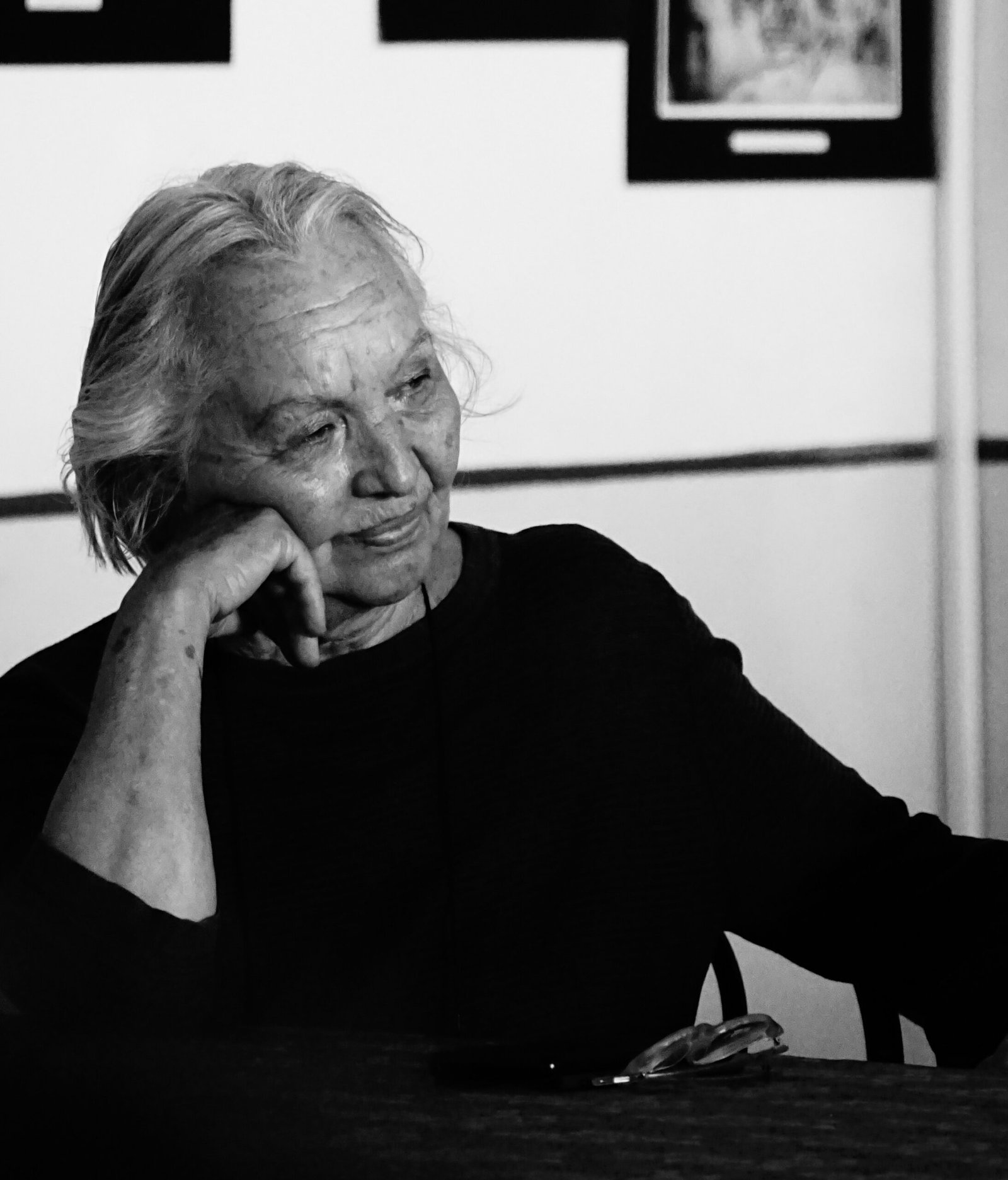
Interviewee: Coudray Michelle
Interviewer: Orecchia Donatella Morganti Arianna
Orecchia Donatella Morganti Arianna
18 July 2025 – Michelle Coudray’s house, Umbertide, Perugia (PG), Italy
Late 1970s – Early 1980s
Keywords
- Ashley Robert
- Bartolucci Giuseppe
- Bene Carmelo
- Benjamin Walter
- Bennink Ham
- Bonito Oliva Achille
- Branciaroli Franco
- Brega Piero
- Buren Daniel
- Castellitto Sergio
- Celant Germano
- Cinque Luigi
- Coen Massimo
- Colombaioni Willi
- Colombo Eugenio
- Conti Bicocchi Maria Gloria
- Coudray Michelle
- Cutarelli Dino
- de Sade Donatien-Alphonse-François
- Dell’Orso Edda
- Fabbri Marisa
- Fabro Luciano
- Fadini Edoardo
- Fuchs Rudi
- Geremia Renato
- Gianelli Ida
- Gordon Peter
- Jonas Joan
- Kounellis Jannis
- Lerici Roberto
- Lessing Gotthold Ephraim
- Lyotard Jean-Francois
- Lucci Massimiliano
- Mango Achille
- Margiotto Domenico
- Marini Giovanna
- Marlowe Christopher
- Mattiacci Eliseo
- Mengelberg Misha
- Menna Filiberto
- Michetti Ulderigo
- Morricone Ennio
- Neumann Andrés
- Nikkels Walter
- Nitsch Hermann
- Paolini Giulio
- Pascali Pino
- Pellion Paolo
- Petroselli Luigi
- Piperno Elsa
- Piperno Giacomo
- Pirandello Luigi
- Prasca Giuliano
- Proietti Gigi
- Quartucci Carlo
- Quartucci Toto
- Saffo
- Scalchi Ada
- Schiaffini Giancarlo
- Schiavoni Piero
- Sudano Rino
- Tatò Carla
- ten Cate Ritzaert
- Van Tieghen David
- von Kleist Heinrich
- Wedekind Frank
- Weiner Lawrence
- 1793, da Parigi by Fuchs Rudi
- Borgatacamion by Camion (directed by Quartucci Carlo)
- Comédìe Italienne by Lerici Roberto, Paolini Giulio and Quartucci Carlo
- Didone by Lerici Roberto (directed by Quartucci Carlo)
- Florville and Courval by de Sade François (directed by Quartucci Carlo)
- Funerale by Lerici Roberto and Kounellis Jannis (directed by Quartucci Carlo)
- Identité Italienne by Celant Germano
- Il fuoco che genera fumo. Il fumo che genera ballerina. Ballerina che genera galli by Kounellis Jannis
- Histoire du soldat by Stravinskij Igor Fёdorovič (directed by Quartucci Carlo)
- L’ultimo spettacolo di Nora Helmer by Camion (directed by Quartucci Carlo)
- Pentesilea by von Kleist Heinrich (directed by Quartucci Carlo)
- Platea by Paolini Giulio and Quartucci Carlo
- Prologo by Paolini Giulio
- Robinson Crusoe mercante di York by Camion (directed by Quartucci Carlo)
- Scene di Periferia by Quartucci Carlo
- Tamerlano Il Grande di Marlowe Christopher (directed by Quartucci Carlo)
- Un teatro musicale - Concerto scenico by Bennink Ham, Colombo Eugenio, Mengelberg Misha and Geremia Geremia
- Uscite by Kounellis Jannis and Quartucci Carlo
- Aranciera di San Sisto Vecchio, Roma
- Berlino
- Castello Colonna, Genazzano (RM)
- Erice
- Genazzano (RM)
- Genova
- Kassel
- Ninfeo del Bramante, Genazzano, (RM)
- Roma
- Compagnia Laboratorio di Camion
- Documenta 7
- Progetto Genazzano
- Zattera di Babele
| DESCRIPTION | ||
| 00:00:00 – 00:05:49
Germano Celant: the definition of Arte Povera and the encounter with Michelle Coudray. |
M.C. Michelle Coudray introduces the discussion of Eliseo Mattiacci and the definition of “Arte Povera” (i.e. Poor Art) coined by Germano Celant, focusing on the role of Pino Pascali and Jannis Kounellis, described as the “leaders of this situation”, and on the composition of the group, “officially” formed by twelve artists, predominantly from the Turin and Rome art scenes.
D.O. Donatella Orecchia asks when the encounter with Germano Celant took place. M.C. Michelle Coudray continues her discussion of the artists associated with Arte Povera, observing that many of them did not understand the reasons for their inclusion within the category. She nevertheless identifies a common element in their desire to move beyond the frame and states that she does not remember the precise chronology of her encounter with Celant, placing it among the “very first group exhibitions”. D.O. Donatella Orecchia asks whether Jannis Kounellis ever felt constrained by the “label” of Arte Povera. M.C. The witness reports that Kounellis considered Arte Povera a generation rather than a unified movement: although each artist pursued an individual line of research, they shared a desire for greater freedom, for overcoming the boundaries of painting and sculpture, for working with living materials, and for engaging with contemporary life. C.T. Carla Tatò emphasises the affinity between these artistic investigations and what was taking place in contemporary society. |
|
| 00:05:50 – 00:09:23
The relationship between Arte Povera and the objet trouvé. |
V.P. Vittorio Pavoncello introduces the theme of the use of contemporary materials and asks Michelle Coudray what relationship the artists associated with the movement established with the objet trouvé.
M.C. Michelle Coudray interprets the objet trouvé as a device capable of producing shifts and contrasts. In the case of Jannis Kounellis, the object carries a memory and is brought into focus according to a principle of harmony; she also recalls that Kounellis always defined himself as a painter. For the other artists, the use of the objet trouvé can instead be understood as an investigation into the characteristics and possibilities of the material. |
|
| 00:09:24 – 00:15:18
Identité Italienne by Germano Celant, Achille Bonito Oliva’s Transavanguardia, and the return to painting. |
D.O. Donatella Orecchia asks about the position and reaction of Carlo Quartucci, Carla Tatò, Jannis Kounellis and Michelle Coudray to Germano Celant’s proposal for Identité Italienne in Paris, also introducing the reference to the Transavanguardia proposed by Achille Bonito Oliva.
M.C. Michelle Coudray places the emergence of a new generation of painters and the return to painting at the end of the 1970s. She recalls Jannis Kounellis’ immediately polemical reaction, motivated by ideological reasons: according to Kounellis, painting needed to rest because both its subject matter and its time had been exhausted. She also distinguishes between the return to painting in Italy and Germany and, with regard to the Italian Transavanguardia, highlights its difference from German painters. She interprets the Transavanguardia as characterised by a strong ideological orientation and by references to the second Fascism and Futurism. |
|
| 00:15:19 – 00:26:20
The renewal of the Quartucci-Kounellis collaboration. Scene di periferia at the Arancera di San Sisto Vecchio. |
D.O. Donatella Orecchia introduces the theme of Genazzano Project.
M.C. Michelle Coudray places the arrival in Genazzano in 1980 and recalls the renewal of the collaboration between Jannis Kounellis, Carlo Quartucci and Carla Tatò at the Aranciera di San Sisto Vecchio in Rome. She interprets the Arancera as an opportunity for Kounellis, who had remained isolated in relation to the return to painting and the logic of the market economy. She also emphasises the artist’s affinity with theatrical space, recalling his dual identity as a painter and a “man of theatre”, and connects his approach to his Greek origins. C.T. Carla Tatò recalls OPERA ovvero Scene di periferia, staged at the Arancera di San Sisto Vecchio. M.C. The witness returns to the centrality of space and describes Kounellis’ intervention through the construction of a small temple, referred to as a “partenope”, and the projection of video fragments from Borgatacamion. The protagonists, seated in a semicircle, are represented as figures belonging to a recognisable society that has believed in a dream and adopts attitudes of “popular nobility”. She interprets the entire work conceived at the Aranciera as an image, specifying that Carlo Quartucci had asked the artist to create an image. |
|
| 00:26:21 – 00:28:55
Genazzano Project and the significance of La Zattera di Babele. |
D.O. Donatella Orecchia introduces the origins of the idea of Genazzano.
M.C. Michelle Coudray recalls the renewal of the relationship between Carlo Quartucci, Carla Tatò and Jannis Kounellis and the proposal of Genazzano, presented by Quartucci and Tatò to Kounellis as an “adventure”. She situates this proposal within an artistic context in which galleries and museums were turning towards a return to painting and describes Kounellis’ position as one of discomfort and isolation in response to this change of direction. She connects this condition to the formation of La Zattera di Babele, interpreted as a state of shipwreck. She also notes the arrival of postmodernism in theatre and the position of Carla Tatò and Carlo Quartucci, who did not embrace it. |
|
| 00:28:56 – 00:37:11
Jannis Kounellis’ work in the spaces of Castello Colonna and its connection with Genazzano’s peasant history and identity. |
D.O. Donatella Orecchia returns to the concept of the objet trouvé, focusing on memory as an element capable of connecting the work of Carlo Quartucci and Carla Tatò with the history of Genazzano, and asks what significance Kounellis’ work in the spaces of Castello Colonna and his engagement with the town’s peasant and social history had for the artist.
M.C. Michelle Coudray recalls the “first scene” consisting of the bottles and identifies the search for an element endowed with the memory of the place as one of the keys to Kounellis’ work. C.T. Carla Tatò intervenes to clarify and reorder Michelle Coudray’s recollections, recalling the billiard table at the Castello as the first action, with the covered woman and the fire burning in the fireplace. M.C. The witness describes an initial phase of listening and outlines Kounellis’ idea of constructing a double structure, likened to a Shakespearean scene, capable of creating an image and establishing a structure within the rooms of Castello Colonna. She emphasises how, in the early episodes, the absence of text makes space the protagonist. With the introduction of text, it remains fragmentary, avoiding a return to the conventions of theatre from which the group had distanced itself and preserving the centrality of the image, which does not function as scenery. She then recalls the first fragment, Didone, associated with the arrival of Roberto Lerici: Kounellis immerses Didone in tongues of fire that delineate its perimeter, a gesture interpreted, in relation to the artist’s Greek origins, as an act of sacralisation. She defines Kounellis as “an ancient man and a modern painter” and recalls Carla Tatò standing on a small pedestal, dressed as a Doric column. With the arrival of Roberto Lerici, she identifies a shift in Quartucci’s theatre towards a greater centrality of text. C.T. Carla Tatò recalls that Aeneas’s journey originated in Palestrina. |
|
| 00:37:12 – 00:48:12
The town’s perception/reaction to Genazzano Project. |
D.O. Donatella Orecchia asks how the town perceived Progetto Genazzano.
M.C. Michelle Coudray recalls the openness of the local community and the presence of Mayor Ulderigo Michetti, emphasising the openness, involvement and interest shown by the municipal administration towards the project. She identifies the aim of “bringing life to Genazzano” as one of the motivations behind the administration’s support. She also recalls the artists involved in the second phase of Genazzano Project, characterised by a national and international opening, and in particular the work created by Luciano Fabro for the entire town, Genealogia. She retraces the collaboration with Germano Celant, who wanted to transform Genazzano into a festival modelled on Spoleto, and his subsequent replacement by Rudi Fuchs. She emphasises how the artists involved in the different editions took the town into account, creating interventions in the streets, squares and within the inhabited fabric of the town. By contrast, she observes that Jannis Kounellis needed a circumscribed space, a perimeter, and recalls how, in the course of these actions, he also became a spectator. |
|
| 00:48:20 – 00:51:30
Documenta 7 under the direction of Rudi Fuchs: cultural conflict between Europe and America. |
D.O. Donatella Orecchia asks whether Michelle Coudray was present at Documenta 7.
M.C. Michelle Coudray confirms her presence and recalls Rudi Fuchs’ curatorial direction, describing the relationship between Fuchs and Germano Celant as a conflict over cultural hegemony and power. She interprets Documenta 7 as a site of a broader cultural conflict between Europe and America and characterises Fuchs as a figure more oriented towards European culture and German painting, in connection with his appointment as director of the exhibition. C.T. Carla Tatò specifies that the artistic direction of Documenta 7 was entrusted to Rudi Fuchs, while Germano Celant participated as the Italian representative. |
|
| 00:51:31 – 00:54:15
Documenta 7 and the different stagings of Funerale in Kassel and Genazzano. |
D.O. Donatella Orecchia introduces the experience of Documenta 7 and asks about the differences between Funerale presented in Kassel and the version staged at the Ninfeo del Bramante in Genazzano.
M.C. The witness recalls Carlo Quartucci, Carla Tatò and Jannis Kounellis as protagonists of that edition and emphasises the positive reception of the scenic actions presented at Documenta, which contributed to the international opening of their work. With regard to Funerale, she interprets the Genazzano version in relation to Italian culture and, in Kounellis’s case, connects it to a Boccionesque vision. C.T. Carla Tatò emphasises the revolutionary character of the Kassel staging, realised in an unprecedented setting such as a disused workshop, and describes the Ninfeo del Bramante as a space of “popular nobility”. |
|
| 00:54:16 – 01:00:07
1970s/80s: was the art world a male-dominated world? |
D.O. Donatella Orecchia asks whether Michelle Coudray perceived the art world of the 1970s and 1980s as a predominantly male environment.
M.C. Michelle Coudray acknowledges that, from a contemporary perspective, that world may be perceived as male-dominated, but specifies that she had not developed this awareness at the time. She recalls the presence of women engaged in writing and criticism, such as Carla Lonzi, and of artists such as Marisa Merz, situating them within a cultural and political climate perceived as subversive. |
|
| 01:00:08 – 01:02:51
Memories of the scenic actions hosted by Progetto Genazzano. |
D.O. Donatella Orecchia asks Michelle Coudray what she remembers, as a spectator, of the presence and scenic actions hosted by Genazzano Project, mentioning, among others, Marina Abramović and Joan Jonas.
M.C. Michelle Coudray recalls above all the atmospheres of the events, while stating that she does not retain many specific details. She describes the residencies in Genazzano as characterised by a continuous coming and going of artists and recalls Carla Tatò’s role in managing these relationships, describing her as “the queen bee”. |
|
| 01:02:52 – 01:11:12
The creative process of Carlo Quartucci and Jannis Kounellis. |
D.O. Donatella Orecchia asks Michelle Coudray how Jannis Kounellis and Carlo Quartucci worked together beyond the framework of Genazzano Project .
M.C. The witness recalls the image of Carlo Quartucci and Carla Tatò arriving at her home with many suitcases and describes the process through which Kounellis listened to the images and words proposed by the two artists. The phrase “Jannis listened without listening” conveys, in her testimony, a mode of listening oriented towards transforming words and ideas into images. She recalls bringing Kounellis the sheets of paper on which the artist produced sketches based on conversations with Quartucci and Tatò. Once conceived, the image became the overall structure of the work, to which further details could be added. She then reconstructs the creative process of Funerale, beginning with Carlo Quartucci’s idea. D.O. Donatella Orecchia describes Carlo Quartucci as a “visionary with words”. |
|
| 01:11:13 – 01:15:22
The theatricality of Jannis Kounellis. |
V.P. Starting from the theatrical dimension of Jannis Kounellis’ work, Vittorio Pavoncello asks Michelle Coudray whether the artist ever worked as a performer.
M.C. Michelle Coudray responds by emphasising Kounellis’ problematic relationship with words and summarising his artistic research through the opposition “either image or theatre”. End of interview. |
|
Interview Duration: All day
Registration Duration: 01:17:41 (01:15:22)
Format: mp3
Type: Audio
Language: Italiano
Subjects:
Original Document Placement:
- ICBSA, Via Caetani 32, 00186, Roma
- Museo Biblioteca dell’Attore
Usage and Rights:
Any use of the material different from listening (except short quotation) is not possible without the prior written consent of ECAD/ORMETE.
Interviews may only be reproduced with permission by ORMETE
Citation
Intervista a Coudray Michelle, di Orecchia Donatella e Morganti Arianna, Casa di Michelle Coudray, Umbertide (PG), il 18/07/2025, Progetto “Progetto Genazzano (1981-1984)”, Collezione Ormete (ORMT-18z), consultata in URL:< http://www.patrimoniorale.ormete.net/en/interview/interview-with-coudray-michelle/.>, (data di accesso).
Relation: Bibliography: