
Interview with Tatò Carla
ORMT-18h
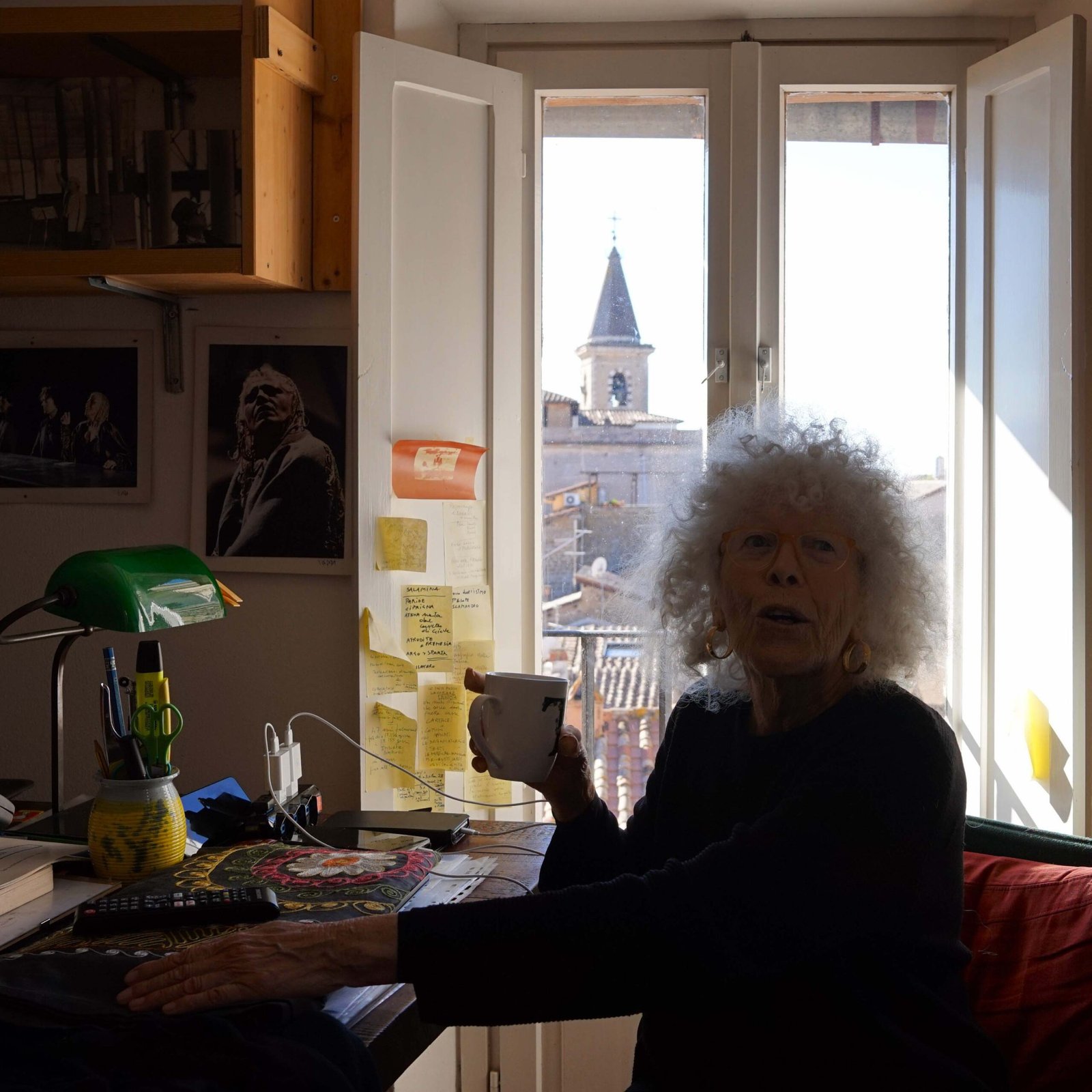
Interviewee: Tatò Carla
Interviewer: Orecchia Donatella Morganti Arianna
Orecchia Donatella Morganti Arianna
14 February 2024 – Carla Tatò’s house, Genazzano, Rome
Early 1980s
Keywords
- Ashley Robert
- Balestrini Nanni
- Benjamin Walter
- Bennink Ham
- Branciaroli Franco
- Brega Piero
- Buren Daniel
- Castellitto Sergio
- Celant Germano
- Cinque Luigi
- Coen Massimo
- Colombaioni Willi
- Colombo Eugenio
- Conti Bicocchi Maria Gloria
- Coudray Michelle
- Cutarelli Dino
- de Sade Donatien-Alphonse-François
- Dell’Orso Edda
- Fabbri Marisa
- Fabro Luciano
- Fadini Edoardo
- Fuchs Rudi
- Geremia Renato
- Gianelli Ida
- Gordon Peter
- Jonas Joan
- Kounellis Jannis
- Lerici Roberto
- Lessing Gotthold Ephraim
- Lucci Massimiliano
- Magli Valeria
- Manet Edouard
- Margiotto Domenico
- Marini Giovanna
- Marlowe Christopher
- Mengelberg Misha
- Michetti Ulderigo
- Morricone Ennio
- Neumann Andrés
- Nikkels Walter
- Nitsch Hermann
- Paolini Giulio
- Pellion Paolo
- Petroselli Luigi
- Piperno Elsa
- Piperno Giacomo
- Pirandello Luigi
- Prasca Giuliano
- Proietti Gigi
- Quartucci Carlo
- Quartucci Toto
- Saffo
- Scalchi Ada
- Schiaffini Giancarlo
- Schiavoni Piero
- Sudano Rino
- Tatò Carla
- ten Cate Ritzaert
- Van Tieghen David
- von Kleist Heinrich
- Wedekind Frank
- Weiner Lawrence
- 1793, da Parigi by Fuchs Rudi
- Borgatacamion by Camion (directed by Quartucci Carlo)
- Comédìe Italienne by Lerici Roberto, Paolini Giulio and Quartucci Carlo
- Didone by Lerici Roberto (directed by Quartucci Carlo)
- Florville e Courval by de Sade François (directed by Quartucci Carlo)
- Funerale by Lerici Roberto and Kounellis Jannis (directed by Quartucci Carlo)
- Il fuoco che genera fumo. Il fumo che genera ballerina. Ballerina che genera galli by Kounellis Jannis
- Histoire du soldat by Stravinskij Igor Fёdorovič (directed by Quartucci Carlo)
- L’ultimo spettacolo di Nora Helmer by Camion (directed by Quartucci Carlo)
- Pentesilea by von Kleist Heinrich (directed by Quartucci Carlo)
- Platea by Paolini Giulio and Quartucci Carlo
- Prologo by Paolini Giulio
- Robinson Crusoe mercante di York by Camion (directed by Quartucci Carlo)
- Scene di Periferia by Quartucci Carlo
- Tamerlano Il Grande by Marlowe Christopher (directed by Quartucci Carlo)
- Un teatro musicale - Concerto scenico by Bennink Ham, Colombo Eugenio, Mengelberg Misha and Geremia Geremia
- Uscite by Kounellis Jannis and Quartucci Carlo
- Aranciera di San Sisto Vecchio, Rome
- Borgata Romanina, Rome
- Castello Colonna, Genazzano (RM)
- Erice
- Fabbrica Salzmann, Kassel
- Genazzano (RM)
- Hotel Cremona, Genazzano (RM)
- Mickery Theatre, Amsterdam
- Museum Fridericianum, Kassel
- Ninfeo del Bramante, Genazzano, (RM)
- Compagnia Laboratorio Camion
- Genazzano Project
- Zattera di Babele
| DESCRIPTION | ||
| 00:00:00 – 00:15:51
The genesis of Uscite and the context of its development between Amsterdam and Genazzano. |
D.O. Drawing on a selection of photographic prints documenting Uscite, Donatella Orecchia invites Carla Tatò to describe the images and clarify the significance of the curtain made of glasses and the configuration of the audience.
C.T. Carla Tatò situates Uscite within a constellation of scenic actions (Didone, Platea, Il fuoco che genera fumo. Il fumo che genera ballerina. La ballerina che genera galli), emphasizing its processual nature. The title is interpreted as encapsulating the theatrical gesture in its entirety: the movement between backstage and stage, and vice versa. Uscite is thus described as a device encompassing the entire act of “making theatre”. Tatò recalls Jannis Kounellis’s intervention in the Sala Martino V, which vertically divided the space and introduced the curtain made of drinking glasses, first created in November 1981 at the Mickery Theatre in Amsterdam for a performance with Valeria Magli (presented by Nanni Balestrini). During that occasion, an initial attempt was also made to project the film Robinson Crusoe onto a frame-like curtain designed by Kounellis. In Genazzano, the scenic device was further developed through the incorporation of wine bottles donated by local farmers, made possible by reinforcing the stage structure. Tatò emphasizes the strong presence of the farming community and its cultural traditions. Following the experience of Vinaliae (featuring the participation of Gigi Proietti) and a subsequent stay at the Avignon Festival, Carla Tatò and Carlo Quartucci came into contact with forms of artistic aggregation characterized by a strong popular and participatory dimension. Returning to Genazzano in 1982, they brought with them experiences acquired in Amsterdam and Avignon, which merged with the stories and memories of the local community. Tatò describes this process as a form of “cultural grafting”. Uscite is remembered as a moment of intense collective engagement, in which spectators as inhabitants expressed an active desire to participate. |
|
| 00:15:52 – 00:24:04
The scenic configuration of Uscite and performative roles. |
D.O. A.M. Donatella Orecchia and Arianna Morganti ask Carla Tatò to clarify the role of the company within Uscite.
C.T. Tatò refers to a photograph taken at the Mickery Theatre, highlighted by Rudi Fuchs in relation to Édouard Manet’s painting A Bar at the Folies-Bergère. The image portrays Carla Tatò blindfolded, configuring her presence as a cognitive enigma. The figure is associated with Edvard Munch’s “silent scream”, underscoring the absence of spoken language on stage. The scenic action unfolds through the entrances and exits of Willy Colombaioni, Piero Brega, Luigi Cinque, and Eugenio Colombo, whose movements physically break some of the glasses composing the curtain. The only vocal element is Piero Brega’s singing, while Carla Tatò and Willy Colombaioni perform in silence. Colombaioni is described as developing a performative practice based on simulated failure (staged falls and deliberately dysfunctional actions). Tatò emphasizes that this scenic configuration marked a significant departure from the working methods previously developed within Genazzano Project. |
|
| 00:24:05 – 00:30:14
The creative process behind Funerale. |
D.O. Donatella Orecchia asks Carla Tatò to reconstruct the creative process behind Funerale.
C.T. Tatò describes the work as emerging from an ongoing dialogue between Carlo Quartucci, Carla Tatò, and Jannis Kounellis. While Kounellis primarily worked through sketches and visual studies, Quartucci and Tatò developed an intense verbal and imaginative exchange, described as a “river” of images and associations. The starting point is identified in the imagery of the Cabaret of the Eleven Executioners, subsequently expanded to encompass other early twentieth-century cabaret traditions, understood as spaces of artistic freedom and non-institutional encounter.Tatò also recalls their participation in the municipal assemblies of Genazzano as a crucial moment of immersion in the local social context.She further mentions Luciano Fabro’s Genealogia, based on the reading aloud of the names of the town’s inhabitants, accompanied by Paolo Pellion’s photographs. The event is interpreted as a moment of collective anticipation and the construction of a shared temporality, consistent with Fabro’s reflection on the relationship between time and theatre. |
|
| 00:30:15 – 00:32:31
Early imaginary configurations of Funerale. |
D.O. Donatella Orecchia invites Carla Tatò to return to the visual conception of Funerale. C.T. Tatò recalls the spatial division of the Sala Martino V and its relationship with the cultural atmosphere of the town. During the period referred to as the “six months of silence” (1981), communication took place primarily through images developed by Jannis Kounellis. Among these, she highlights the vision of a bipartite scenic space: the upper level occupied by the actors, and the lower level associated with institutional life, represented by the mayor and the municipal assemblies. | |
| 00:32:32 – 00:43:16
Scenic transformation of Funerale and the concept of the “Dramaturgy of the Arts”. |
D.O. Donatella Orecchia comments on the differences between the initial visual conceptions of Funerale and its later stagings in Kassel and at the Ninfeo del Bramante.
C.T. Tatò refers to the production presented in Berlin and to the historical context marked by the existence of the Berlin Wall. She defines the “Dramaturgy of the Arts” as a practice grounded in dialogue with space, understood as an active and generative element. The initial visual concepts acquire concrete form through their interaction with specific sites. In Kassel, the chosen venue was a disused factory characterized by a large glass façade overlooking the city. D.O. Donatella Orecchia asks for clarification regarding the relationship between artistic conception and spatial adaptation. C.T. Tatò describes Castello Colonna as a site marked by profound historical stratification, which decisively shaped the creative process. Space itself is conceived as an “author” with whom the artists establish an ongoing dialogue. D.O. Donatella Orecchia offers an interpretative synthesis of the process. C.T. Tatò explains that the urgency behind Funerale emerged from the sedimentation of the Genazzano experience and from the challenges of working within the ruined state of Castello Colonna. As a result, the scenic action developed horizontally rather than vertically. During the initial phase of conception, no dramatic text existed; it was only later that Roberto Lerici introduced the textual dimension. |
|
| 00:43:17 – 00:44:33
The relationship with Edoardo Fadini during Genazzano Project. |
D.O. Donatella Orecchia asks about Carla Tatò’s relationship with Edoardo Fadini during the years of Genazzano Project.
C.T. Carla Tatò recalls the cabaret experience and refers to the Cabaret Voltaire founded by Edoardo Fadini in the 1970s. At Genazzano, Fadini embraced the concept of the Cabaret of the Eleven Hangmen, in continuity with the path initiated during Camion. Their relationship is described as a form of “brotherhood at a distance”, grounded in a longstanding sharing of artistic practices and critical reflection. |
|
| 00:44:34 – 00:48:58
The role of Rudi Fuchs and Germano Celant within Genazzano Project. |
D.O. Donatella Orecchia asks about the role of Rudi Fuchs within the Genazzano Project.
C.T. Carla Tatò describes Rudi Fuchs as responsible for the project’s artistic and institutional relationships, emphasizing what she characterizes as his “revolutionary” approach. His contribution is also recalled in relation to subsequent experiences, including the project at Erice. Tatò further recalls her relationship with Germano Celant, which had begun during the Camion experience and focused on the development of an international artistic network, particularly involving artists from the United States working primarily in the fields of performance and experimental cinema. |
|
| 00:48:59 – 01:06:31
The fragment as an aesthetic and operative principle. |
D.O. Donatella Orecchia returns to the concept of the fragment.
C.T. Carla Tatò connects the notion of the fragment to the experiences developed in the Roman suburbs and to her work with the Canzoniere del Lazio. The fragment is understood as part of a broader spatial whole – whether a suburb or a town -capable of containing and articulating multiple artistic and social elements. At Genazzano, this larger whole is represented by the town itself; in Rome, by the suburb of Romanina. In both contexts, artistic practice is characterized by the simultaneous engagement with heterogeneous materials, including classical texts (Henrik Ibsen), modern literature (Robinson Crusoe), and contemporary productions such as Scene di periferia (1978). D.O. Donatella Orecchia asks about the relationship between the concept of the fragment and the practice of cabaret. C.T. Carla Tatò associates the experience at Castello Colonna with a profound sense of artistic freedom and a revolutionary dimension comparable to that of the historical cabarets, understood as spaces operating outside the conventions of bourgeois cultural institutions. End of interview. |
|
Interview Duration: 06:00:00 approximately
Registration Duration: 01:06:31
Format: wav
Type: Audio
Language: Italian
Subjects:
Original Document Placement:
- ICBSA, Via Caetani 32, 00186, Roma
- Museo Biblioteca dell’Attore, Via del Seminario 10, 16121, Genova
Usage and Rights:
Any use of the material different from listening (except short quotation) is not possible without the prior written consent of ECAD/ORMETE.
Interviews may only be reproduced with permission by ORMETE
Citation
Interview with Carla Tatò, conducted by Donatella Orecchia and Arianna Morganti, at Carla Tatò’s home in Genazzano (RM), on 14 February 2024, “Progetto Genazzano (1981–1984)”, Ormete Collection (ORMT-18h), consultata in URL:< https://patrimoniorale.ormete.net/interview/interview-with-tato-carla-5/>, (data di accesso).
Relation: Bibliography: