
Interview with Tatò Carla
ORMT-18e
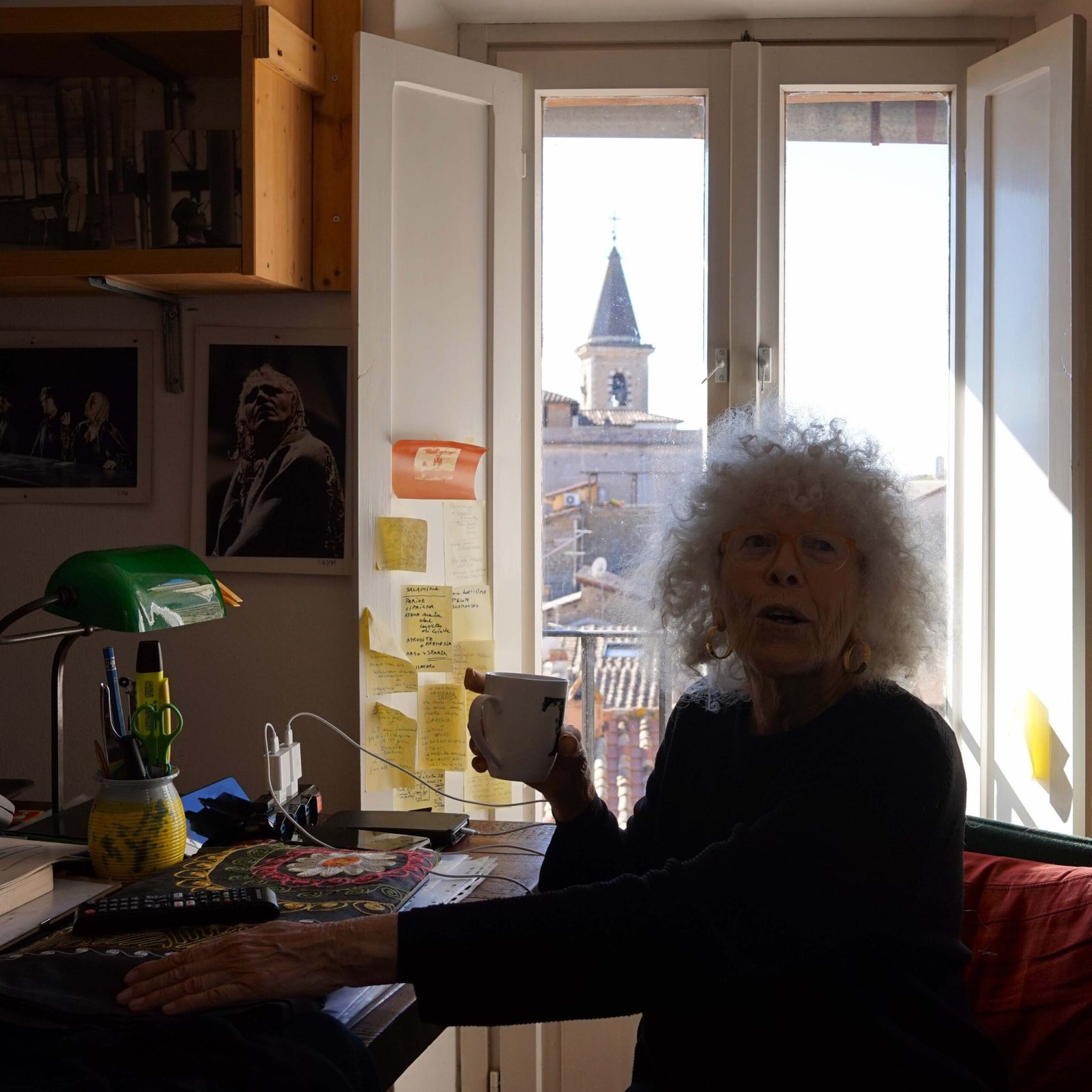
Interviewee: Tatò Carla
Interviewer: Orecchia Donatella Morganti Arianna
Orecchia Donatella Morganti Arianna
3 December 2023 – Carla Tatò’s house, Genazzano, Rome
Early 1980s
Keywords
- Ashley Robert
- Benjamin Walter
- Bennink Ham
- Branciaroli Franco
- Brega Piero
- Buren Daniel
- Castellitto Sergio
- Celant Germano
- Cinque Luigi
- Coen Massimo
- Colombaioni Willi
- Colombo Eugenio
- Conti Bicocchi Maria Gloria
- Coudray Michelle
- Cutarelli Dino
- de Sade Donatien-Alphonse-François
- Dell’Orso Edda
- Fabbri Marisa
- Fabro Luciano
- Fuchs Rudi
- Geremia Renato
- Gianelli Ida
- Gordon Peter
- Jonas Joan
- Kounellis Jannis
- Lerici Roberto
- Lessing Gotthold Ephraim
- Marini Giovanna
- Marlowe Christopher
- Mengelberg Misha
- Michetti Ulderigo
- Morricone Ennio
- Neumann Andrés
- Paolini Giulio
- Pellion Paolo
- Petroselli Luigi
- Piperno Elsa
- Piperno Giacomo
- Pirandello Luigi
- Prasca Giuliano
- Proietti Gigi
- Quartucci Carlo
- Quartucci Toto
- Saffo
- Scalchi Ada
- Schiaffini Giancarlo
- Tatò Carla
- ten Cate Ritzaert
- Van Tieghen David
- von Kleist Heinrich
- Wedekind Frank
- 1793, da Parigi by Fuchs Rudi
- Borgatacamion by Camion (directed by Quartucci Carlo)
- Comédìe Italienne by Lerici Roberto, Paolini Giulio and Quartucci Carlo
- Didone by Lerici Roberto (directed byQuartucci Carlo)
- Florville e Courval by de Sade François (directed by Quartucci Carlo)
- Funerale by Lerici Roberto and Kounellis Jannis (directed by Quartucci Carlo)
- Il fuoco che genera fumo. Il fumo che genera ballerina. Ballerina che genera galli by Kounellis Jannis
- Histoire du soldat by Stravinskij Igor Fёdorovič (directed byQuartucci Carlo)
- L’ultimo spettacolo di Nora Helmer by Camion (directed byQuartucci Carlo)
- Pentesilea by von Kleist Heinrich (directed by Quartucci Carlo)
- Platea by Paolini Giulio and Quartucci Carlo
- Prologo by Paolini Giulio
- Robinson Crusoe mercante di York by Camion (directed by Quartucci Carlo)
- Scene di Periferia by Quartucci Carlo
- Tamerlano Il Grande di Marlowe Christopher (directed by Quartucci Carlo)
- Un teatro musicale - Concerto scenico by Bennink Ham, Colombo Eugenio, Mengelberg Misha and Geremia Geremia
- Uscite by Kounellis Jannis and Quartucci Carlo
- Castello Colonna, Genazzano (RM)
- Fabbrica Salzmann, Kassel
- Firenze
- Genazzano (RM)
- Mickery Theatre, Amsterdam
- Museum Fridericianum, Kassel
- Ninfeo del Bramante, Genazzano, (RM)
- Roma
- Teatro Nuovo, Spoleto (PG)
- Cabaret degli Undici Boia
- Compagnia Laboratorio di Camion
- Documenta 7
- Progetto Genazzano
| DESCRIPTION | ||
| 00:00:00 – 00:06:20
Travel and dream as creative paradigms.. |
D.O. Donatella Orecchia resumes the final segment of the interview with Carla Tatò conducted on 26 November 2023.
C.T. Carla Tatò refers to the document Organisation of a Working Group with Research Grants (1981), preserved in the Carlo Quartucci-Carla Tatò Archive, Museo Biblioteca dell’Attore, Genova. Carla Tatò describes the company as a community of “travellers”, both in a physical and a mental sense. She defines theatrical practice not as a distinct rehearsal phase but as a permanent condition: “They were not rehearsals for a performance. I never rehearsed, especially during my theatrical life travelling with Carlo… I never rehearsed, and yet we were always rehearsing. It was a life in rehearsal, because travelling, as a continuous process of discovery, transforms you. It was a continuous metamorphosis” (00:01:17-00:01:48). Travelling, understood as a process of knowledge, generates the constant transformation of both performer and theatrical device. Within this framework, space – particularly Genazzano, marked by conditions of decay and discontinuity – acts as an active agent in the creative process: the relationship with the site and its inhabitants stimulates artistic experimentation and nurtures the desire to inhabit the place through performance. |
|
| 00:06:21 – 00:15:56
The local community and the concept of “shipwrecked culture”. |
D.O. Donatella Orecchia reads excerpts from the document Notes for an Agreement (1981), preserved in the Carlo Quartucci–Carla Tatò Archive, Museo Biblioteca dell’Attore, Genova.
C.T. Carla Tatò distinguishes the context of the Roman suburbs from that of the smaller towns in the Province of Rome. Whereas artistic intervention in the suburbs took the form of political confrontation, the smaller communities were characterised by stronger social cohesion and relational openness, enabling shared forms of participation. Local peasant culture – exemplified by the wine festival Vinaliae – is presented as the structural foundation of the community. Within this context, each inhabitant assumed an active role in the creative process (“every citizen was a column”), contributing directly to the development of performances such as Uscite. Tatò further develops the notion of “shipwrecked culture” through a dual genealogy: on the one hand, the European literary tradition (Lessing and Kleist); on the other, the performative traditions of Central European cabaret, particularly the Cabaret of the Eleven Executioners. The Prologue and the film Florville e Courval are presented as the inaugural artistic devices through which this reflection was articulated. |
|
| 00:15:57 – 00:18:30
Creative devices and the dramaturgy of space. |
D.O. Donatella Orecchia asks about the use of photographs in Giulio Paolini’s Prologue.
C.T. Carla Tatò relates this choice to the theatrical research developed from 1977 onwards (New Theatre Festival, Spoleto), centred on the dual perspective of actor and spectator. D.O. Donatella Orecchia asks about the meaning of Paolini’s curtain. C.T. Upon arriving in Genazzano, previously used scenic materials were re-employed and reconfigured in new artistic settings. Platea (1982), created by Giulio Paolini and Carlo Quartucci in the Sala Martino V, introduced the curtain as a layered theatrical device capable of generating multiple levels of meaning. |
|
| 00:18:31 – 00:21:28
Voice, listening, and economic sustainability. |
D.O. Carla Tatò describes an initial phase characterised by the suspension of spoken language and an attentive listening to space, perceived as acoustically and perceptually resistant. Sound was therefore entrusted primarily to music – for example, Renato Geremia’s violin in Jannis Kounellis’s Prologue.
D.O. Donatella Orecchia asks about the local community’s response. C.T. The audience responded immediately and enthusiastically, participating actively both in the performances and in the convivial environment of the Teatroteca. D.O. Donatella Orecchia refers to the document Organisation of a Working Group with Research Grants, preserved in the Carlo Quartucci-Carla Tatò Archive, Museo Biblioteca dell’Attore, Genova. C.T. Tatò explains that the proposed project was never fully implemented because of limited institutional support. She highlights the company’s financial difficulties and the substantial debts accumulated while independently sustaining the project. |
|
| 00:21:29 – 00:26:20
Open workshops and artistic networks. |
D.O. Donatella Orecchia refers to the document Teatroteca – Progetto Genazzano (1981), preserved in the Carlo Quartucci–Carla Tatò Archive, Museo Biblioteca dell’Attore, Genova.
C.T. The educational activities are described as open seminars designed to share creative processes rather than merely teach performance techniques. Among the key participants was the singer Edda Dell’Orso, introduced through the mediation of Marisa Fabbri. Connections between theatre, music, and cinema also emerge through projects such as the reinterpretation of Penthesilea (Kleist) and the production of audiovisual works in the Genazzano area. |
|
| 00:26:21 – 00:31:06
Workshop practice and community participation. |
A.M. Arianna Morganti asks about the objectives of the workshops.
C.T. Carla Tatò explains that the workshop was conceived as a tool for fostering awareness within the local community. Drawing on the experience of Camion, the approach was based on openness and direct interaction with local residents through public assemblies and widespread communication systems, including loudspeakers. Peasant culture is recognised as the foundation of listening and social relations, playing a decisive role in the success of the project. “Peasant culture was sovereign […]. It was an ancient culture capable of listening, and this, in my opinion, determined the real success of the whole experience of Genazzano” (00:30:36 – 00:31:06). |
|
| 00:31:07 – 00:37:58
The dialectic between local and international dimensions. Germano Celant’s artistic programme. |
D.O. Donatella Orecchia introduces the international phase of Genazzano Project (1981–1982).
C.T. Carla Tatò recalls establishing contact with Ritsaert ten Cate (Mickery Theatre, Amsterdam) and the international circulation of productions such as Nora Helmer and Robinson Crusoe. The year 1982 marked a significant expansion of the project. Under the curatorial direction of Germano Celant, the programme increasingly focused on the American experimental scene, featuring artists such as Bob Ashley, Peter Gordon, David Van Tieghem, and Joan Jonas, representative figures of the American New Wave. |
|
| 00:37:59 – 00:43:39
Interdisciplinary and “artistic friendship”. |
D.O. Donatella Orecchia asks about the relationship between the various artistic practices involved in the project.
C.T. Carla Tatò emphasises Celant’s curatorial ability to bring together heterogeneous artistic practices without generating competition, instead encouraging interdisciplinary dialogue. Genazzano fostered a climate of shared artistic practice that Tatò defines as “artistic friendship,” in which musicians, performers, and visual artists worked in continuous interaction within the same creative environment. |
|
| 00:43:40 – 00:44:43
The temporal organisation of the project. |
D.O. Donatella Orecchia asks about the temporal organisation of the activities.
C.T. The project was organised around intensive working periods that concentrated workshops, seminars, and performances. Some members of the company – including Carlo Quartucci, Carla Tatò, Jannis Kounellis, and Michelle Coudray – lived permanently in Genazzano, while guest artists were accommodated in local facilities. |
|
| 00:44:44 – 00:53:43
Didone: dramaturgical construction and the reactivation of voice (Carla Tatò). |
D.O. Donatella Orecchia asks about the recovery of Carla Tatò’s voice in 1982 in relation to the performance Didone.
C.T. Carla Tatò describes the vocal difficulties posed by the acoustics of Castello Colonna, whose strong reverberation made vocal control particularly challenging. The work therefore evolved into a technical and performative exploration aimed at “cutting through” the space, including the use of fabrics to modify sound propagation. A clear division of creative responsibilities emerged: Carla Tatò focused on vocal research, Jannis Kounellis on the visual construction of the stage image, and Carlo Quartucci on the overall organisation of the theatrical apparatus. Tatò recalls how observing the Palestrina Mosaic together with Roberto Lerici inspired the dramaturgical concept of Didone, linking Aeneas’ arrival in Latium to the performance. Lerici’s text developed through a process of translation and rewriting, drawing simultaneously on classical sources (Virgil) and modern literature (Marlowe). The performance was conceived as an immersive and conflictual environment. Visual elements (Kounellis’s “tongues of fire”), musical compositions (Giancarlo Schiaffini, Eugenio Colombo, Luigi Cinque, and Massimo Coen), and acoustic effects (the dry sound of billiard balls) combined to create a pervasive atmosphere of tension reminiscent of warfare. D.O. Donatella Orecchia asks why Didone was chosen. C.T. Tatò explains that the decision emerged directly from the spatial qualities of Genazzano itself. Didone is presented as a journey, moving from Virgil’s Latin to Roberto Lerici’s Italian adaptation. |
|
| 00:53:44 – 00:54:27
The function of the narrator. |
D.O. Donatella Orecchia refers to the figure of the Narrator, already central to the experience of Camion.
C.T. Carla Tatò describes the narrator as a device of verification and regeneration, evoking an almost tactile mode of acquiring knowledge. D.O. Donatella Orecchia asks about the audience’s response. C.T. The reception is described as overwhelmingly positive, to the extent of becoming what Tatò defines as an “epoch-making success”. |
|
| 00:54:28 – 01:00:19
Didone at Documenta 7: transposition and spatial adaptation. |
D.O. Donatella Orecchia asks about the different versions of Didone.
C.T. Carla Tatò emphasises the need to adapt the scenic score to different spatial contexts, particularly in the transition from Genazzano to Documenta 7. Contact with Rudi Fuchs, who mediated the invitation, was established through Jannis Kounellis. The exhibition space in Kassel – described as a hybrid museum-theatre – required a perceptual and scenographic reconfiguration: spectatorship was organised from the ground upwards, producing an effect of vertical immersion. |
|
| 01:00:20 – 01:01:45
Didone in Kassel: scenic variations. |
C.T. In the Kassel version, the performance underwent further transformations. The flames were replaced by a human composition consisting of Prussian cadets arranged in a circular formation. The performance space was organised into a tripartite structure: Tatò occupied the centre, while a jazz ensemble and a classical dancer were positioned on either side. This arrangement foregrounded the productive tension between different performative languages. | |
| 01:01:46 – 01:05:47
Funerale in Kassel: industrial space and ritual dimension. |
DO. Donatella Orecchia refers to Funerale at Documenta 7, first staged in the Salzmann Factory, Kassel, and subsequently at the Ninfeo del Bramante in Genazzano.
CT. Carla Tatò recalls the logistical and material challenges involved in the production, including transporting horses into the industrial space. The performance took place inside a former textile factory characterised by visual openings onto the city and by a temporal progression following the transition from sunset to night. The performance ensemble was deliberately heterogeneous and international, bringing together opera singers, jazz musicians, actors, and dancers. Tatò traces the dramaturgical origins of Funerale to the Cabaret of the Eleven Executioners and the funeral of Frank Wedekind, outlining a genealogy that intertwined political theatre with performative ritual. |
|
| 01:05:48 – 01:07:45
The role of Carlo Quartucci. |
D.O. Donatella Orecchia asks about Carlo Quartucci’s role within the project.
C.T. Tatò emphasises Quartucci’s function as the overall coordinator of the production. He supervised every aspect of the creative process, from directing performers to overseeing costume design. |
|
| 01:07:46 – 01:12:43
Collectivity, risk, and improvisation. |
D.O. Donatella Orecchia compares Funerale, characterised by its collective dimension, with the solitary structure of Didone.
C.T. Carla Tatò highlights the contrast between the collective support provided by the performative procession in Funerale – including the presence and artistic dialogue with Elsa Piperno in Genazzano – and the condition of performative isolation experienced in Didone. D.O. Donatella Orecchia asks about the degree of improvisation. C.T. The instability of scenic elements, particularly the horses in Funerale, introduced an element of unpredictability and genuine risk. According to Tatò, this condition was deliberately sought by Quartucci and Kounellis as an integral dramaturgical component. |
|
| 01:12:44 – 01:14:13
Authorial presence and reception at Documenta 7. |
D.O. Donatella Orecchia asks about the presence of Jannis Kounellis and Carlo Quartucci during the performances.
C.T. Tatò explains that both remained actively involved throughout the performances, staying at the margins of the action while remaining ready to intervene whenever necessary. D.O. Donatella Orecchia asks about the positioning of the work within Documenta 7. C.T. Carla Tatò stresses the company’s awareness of presenting an autonomous and distinctive artistic research capable of engaging with different interpretative contexts without losing its own specificity: “Yes, because we knew we were carrying something unique that could be approached from different perspectives. Therefore, although it was absolute in itself, it did not prevent people from experiencing it in other ways” (01:13:31-01:14:00). |
|
| 01:14:14 – 01:16:51
Genazzano and the European context. |
D.O. Donatella Orecchia asks about the relationship between the local dimension of Genazzano and the broader European context.
C.T. The European experience is described as a space of freedom and discovery, whereas returning to Genazzano represented a process of reflection and restitution. |
|
| 01:16:52 – 01:21:16
Ninfeo del Bramante: practices of inhabiting space. |
D.O. Donatella Orecchia asks about the staging of Funerale at the Ninfeo del Bramante.
C.T. Carla Tatò recalls the challenges of inhabiting the Ninfeo del Bramante. She describes the intervention, designed by Toto Quartucci, as intentionally non-invasive: the site was respected in its original configuration, with only functional, non-transformative additions such as wooden flooring. |
|
| 01:21:17 – 01:23:15
Reactivating the Ninfeo del Bramante. |
D.O. Donatella Orecchia asks about the previous use of the Ninfeo del Bramante by the inhabitants of Genazzano and its subsequent reuse within Genazzano Project.
C.T. Previously regarded as a marginal and abandoned place – referred to as the “witches’ wood” – the Ninfeo was gradually reactivated through the joint efforts of the artists and the local administration. |
|
| 01:23:16 – 01:24:18
Artistic production at the Ninfeo del Bramante. |
D.O. Donatella Orecchia refers to Comédie Italienne at the Ninfeo del Bramante.
C.T. Tatò recalls Comédie Italienne, Funerale, and Edith Christiansen Buñuel. The Ninfeo became a site of continuous artistic experimentation, fostering a growing sense of belonging and collective appropriation within the local community. |
|
| 01:24:19 – 01:28:55
The cultural transformation of the territory. |
A.M. Arianna Morganti reflects on the circular dimension of travel between Europe and Genazzano, which had become a crossroads of artistic practices.
C.T. Carla Tatò describes Genazzano as a close-knit community deeply rooted in peasant culture. |
|
| 01:28:56 – 01:36:50
Reading Ritsaert Ten Cate’s testimony. |
D.O. Donatella Orecchia reads the text by Ritsaert Ten Cate, In Amsterdam, 15–30 November 1981, published in Progetto Genazzano (1982), preserved in the Carlo Quartucci-Carla Tatò Archive, Museo Biblioteca dell’Attore, Genova. | |
| 01:36:51 – 01:50:11
Comédie Italienne and Dispositif Scénique No. 1 at the Ninfeo del Bramante. |
D.O. Donatella Orecchia evokes the performative space of the Ninfeo del Bramante.
C.T. Carla Tatò describes the scenic configuration of Comédie Italienne, highlighting the use of the architectural columns as structural elements, the presence of multiple curtains, and the dynamic distribution of performers throughout the space. End of interview. |
|
Interview Duration: 06:00:00 approximately
Registration Duration: 01:50:11
Format: wav
Type: Audio
Language: Italian
Subjects:
Original Document Placement:
- ICBSA, Via Caetani 32, 00186, Roma
- Museo Biblioteca dell’Attore, Via del Seminario 10, 16121, Genova
Usage and Rights:
Any use of the material different from listening (except short quotation) is not possible without the prior written consent of ECAD/ORMETE.
Interviews may only be reproduced with permission by ORMETE
Citation
Interview with Carla Tatò, conducted by Donatella Orecchia and Arianna Morganti, at Carla Tatò’s home in Genazzano (RM), on 03 December 2023, “Progetto Genazzano (1981–1984)”, Ormete Collection (ORMT-18e), consulted in URL:< https://patrimoniorale.ormete.net/interview/interview-with-tato-carla-2/>, (access date).
Relation: Bibliography: