| DESCRIPTION |
| 00:00:00 – 00:09:32
In situ research, mourning for the death of Giovanna Marini, and the contemporary relevance of the archive. |
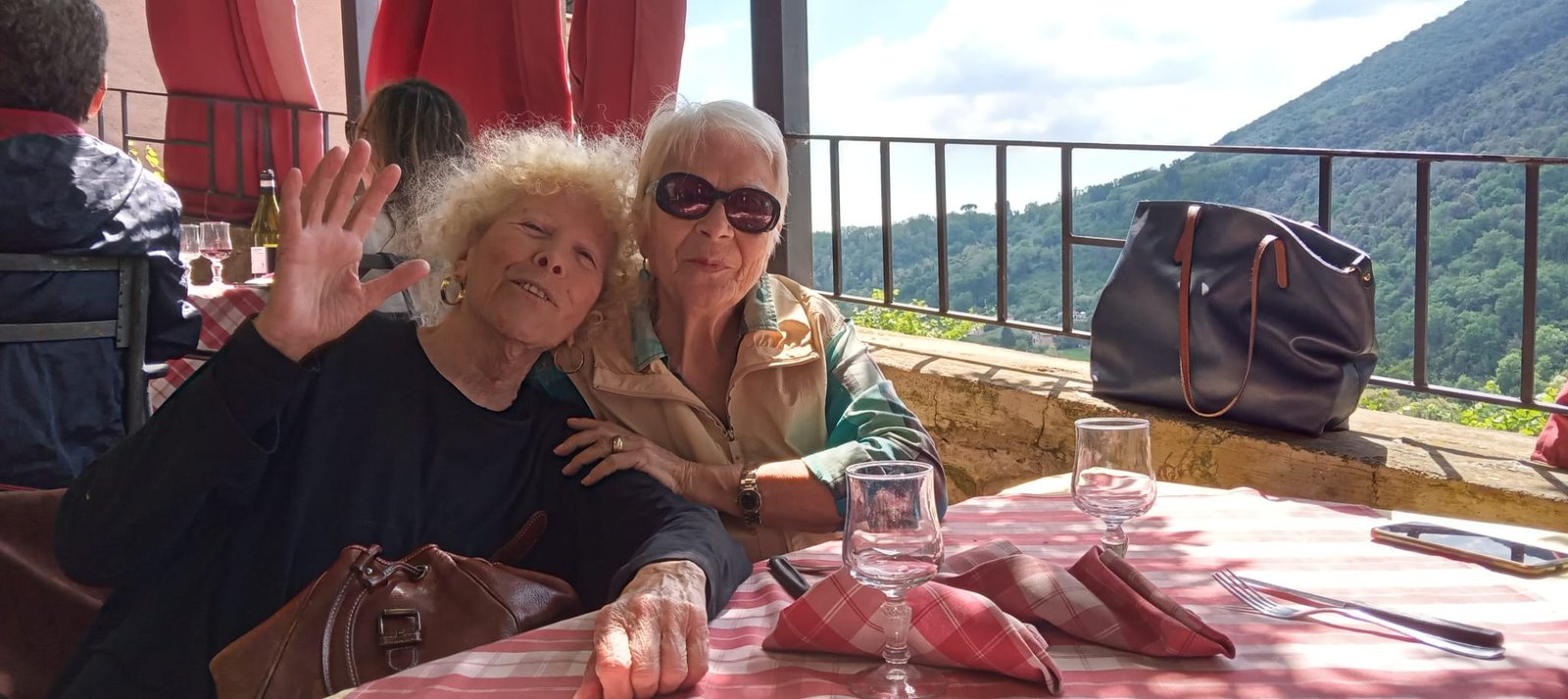
D.O. The interview opens with Donatella Orecchia presenting the volume Stravedere la scena and outlining the methodological framework of the ongoing research, based on the integration of archival research and in situ oral history.
A.S. Ada Scalchi introduces an emotionally charged reference to the recent death of Giovanna Marini (8 May 2024), which had occurred only a few days before the interview.
C.T. Carla Tatò provides an update on the current situation of Colonna Castle and on the preservation and deposit of the Carlo Quartucci–Carla Tatò Fonds. |
| 00:09:33 – 00:13:18
The origins of Genazzano Project and the political-administrative framework of the Province of Rome. |
D.O. Donatella Orecchia asks Ada Scalchi about her earliest memories of Carla Tatò and Carlo Quartucci, focusing on their first encounter and the beginnings of Genazzano Project.
A.S. Ada Scalchi recalls their youth, describing both as figures of extraordinary creative energy: Carla Tatò as a “volcano”, and Carlo Quartucci as initially more reserved, though equally volcanic in his creative force. The context is that of the Province of Rome between 1977 and 1978, during a programme aimed at acquiring historic buildings throughout the province, including Colonna Castle in Genazzano. Within this institutional framework emerged the idea of establishing in Genazzano a structured and long-term cultural project, characterised by a strong creative impulse and a grassroots orientation. Scalchi emphasises the exceptional nature of those years, which she now describes as “indescribable” in terms of vitality and experimental ambition, contrasting them with the proliferation of cultural initiatives perceived as ephemeral within the Roman context. |
| 00:13:19 – 00:20:43
Shared political commitment and cultural decentralisation. |
D.O. Donatella Orecchia asks whether Ada Scalchi’s encounter with Carla Tatò and Carlo Quartucci occurred through her familiarity with the Camion experience or directly through Genazzano Project.
A.S. Ada Scalchi clarifies that their acquaintance originated in a shared political commitment, whereas the Genazzano project represented a distinct and specific development.
D.O. Donatella Orecchia asks whether there were other experiences of cultural and theatrical decentralisation contemporaneous with Genazzano Project that Ada Scalchi encountered during her tenure in public office.
A.S. In her role within the Department for Youth and Cultural Decentralisation, Scalchi was at the beginning of her administrative career. The objective was to bring theatre and cultural activities to the municipalities of the province (117 at the time), promoting performances in public squares and supporting groups such as the Collettivo Isabella Morra and the Teatro della Maddalena. According to Scalchi, what distinguished Progetto Genazzano from other decentralisation initiatives was its capacity to endure over time: “they created something that remained”. It was not an isolated event but a lasting cultural construction.
Ada Scalchi also recalls the political context of the so-called Giunte Rosse (i.e., red administrations) established in many municipalities of the province and in Rome itself, a framework that encouraged institutional openness towards cultural experimentation. She further mentions the resistance encountered in certain local contexts—for example, ecclesiastical opposition to performances staged in public squares (referring here to an episode involving the Collettivo Isabella Morra in Palombara Sabina)—as evidence of the challenges involved in rooting cultural initiatives within local communities. |
| 00:20:44 – 00:22:14
Personal participation. |
D.O. Donatella Orecchia asks whether Ada Scalchi regularly visited Genazzano during the years of Genazzano Project.
A.S. Ada Scalchi states that she frequented Genazzano regularly in connection with her institutional responsibilities. In addition to emphasising the creativity of Tatò and Quartucci, she highlights their professionalism and organisational skills. Her memories are also intertwined with convivial and everyday aspects of the experience, including local food, which was one of the reasons she often travelled to Genazzano. |
| 00:22:15 – 00:25:44
Ada Scalchi’s memories.
Colonna Castle as an empty space and an imagined space. |
D.O. Donatella Orecchia shows several photographs related to Genazzano Project.
A.S. The photographs trigger memories connected to the practical and organisational dimensions of the project: “for them it was all about working”.
C.T. [Referring to the photographs] Carla Tatò describes the space of the Sala Martino V, Castello Colonna.
A.S. Colonna Castle is remembered as an empty and partially ruined space. “Perhaps in their minds they already had everything they wanted and were able to do there” (00:33:50–00:33:55). By contrast, the Ninfeo del Bramante remains a more indistinct and fragmented memory for the witness. |
| 00:25:45 – 00:31:52
Carlo Quartucci’s Camion and its cultural legacy. |
A.S. Ada Scalchi asks for news about Carlo Quartucci’s white Camion.
C.T. Carla Tatò reconstructs the final history of Camion, referring both to the proposal advanced by Rudi Fuchs to preserve it within a museum context and to Quartucci’s own desire to dismantle it; ultimately, Camion “faded away” over time.
D.O. Donatella Orecchia asks whether, from Ada Scalchi’s perspective, the actions undertaken by Carlo Quartucci and Carla Tatò influenced the artistic and cultural landscape and left a lasting legacy, including at the political level.
A.S. Ada Scalchi affectionately refers to Quartucci and Tatò as “the mad ones”, situating them within the climate of political struggles and demonstrations that characterised her generation. She recalls the 1970s not as a fleeting period but as a decade marked by concrete achievements (including family law reform and divorce legislation) and by profound transformations in relation to a previously patriarchal culture. |
| 00:31:53 – 00:34:34
After Genazzano Project: the interruption of cultural initiatives and institutional dynamics. |
D.O. Donatella Orecchia observes that the conclusion of Genazzano Project coincided with the interruption of similar cultural initiatives and asks Ada Scalchi what, in her view, may have caused this shift.
A.S. Reflecting on the end of Genazzano Project and the absence of comparable subsequent experiences, Ada Scalchi attributes responsibility in part to political discontinuity and to a lack of full cultural awareness. She also emphasises the difficulties encountered, particularly as a woman holding public office, alongside administrator Lina Ciuffini, in supporting avant-garde cultural projects.
D.O. Donatella Orecchia asks about the relationship between the Province of Rome and the Municipality of Rome during the late 1970s and early 1980s.
A.S. A complex institutional dynamic emerges between the Province and the Municipality. The Province is described as being closer to citizens, whereas Rome appears more distant. Scalchi also refers to the politics of the “ephemeral”, associated with Renato Nicolini’s cultural policies. |
| 00:34:35 – 00:40:45
Renato Nicolini’s cultural policies: centre and suburbs. |
D.O. Donatella Orecchia asks Ada Scalchi about her personal and institutional position, both then and now, regarding Renato Nicolini’s cultural initiatives.
A.S: Renato Nicolini’s cultural policies are assessed critically. According to Scalchi, Rome maintained a somewhat “snobbish” attitude towards the Province; cultural decentralisation often remained confined within the city’s administrative districts (particularly the Fourth and Fifth Districts) without extending beyond the Grande Raccordo Anulare (Rome’s ring road). She reiterates the need, strongly felt at the time, to construct a genuine metropolitan area through collaboration between the Province and the Municipality, while the Region mainly intervened through financial support. A lack of institutional unity of purpose is highlighted.
C.T. Carla Tatò acknowledges having had a positive personal relationship with Renato Nicolini but clearly distinguishes this from questions of cultural policy. She explains that the decision to remain in central Rome (at the Aranciera di San Sisto Vecchio) with the Camion delle borgate was a conscious political choice: “our decision to remain in central Rome, at the Aranciera di San Sisto Vecchio with the Camion delle borgate, was a political choice, a cultural policy choice” (00:47:04–00:47:17). She recalls the difficulties faced by institutional cultural policies in sustaining artists over time, as well as a tendency to concentrate resources on single flagship projects such as the Castelporziano Festival. Renato Nicolini is described as a major cultural and political strategist. |
| 00:40:46 – 00:43:45
The encounter between Carla Tatò and Ada Scalchi: political activism and territorial networks. |
D.O. Donatella Orecchia asks about the circumstances under which Carla Tatò and Ada Scalchi first met. .
C.T. Carla Tatò explains that their encounter took place within a political context.
A.S. Scalchi recalls her role as a municipal councillor in Ardea, alongside Mario Ugazzi, and emphasises the importance of Antonio Tatò’s house in Tor San Lorenzo as a meeting place.
The discussion evokes significant political figures, such as Giglia Tedesco, as well as social contexts marked by tensions related to illegal building practices and speculative development along the coastline. The Italian Communist Party (PCI) is remembered as a space of protection, solidarity, and collective belonging. |
| 00:43:46 – 00:45:50
Political presences: Enrico Berlinguer in Genazzano. |
D.O. Donatella Orecchia recalls a key episode in Genazzano’s collective memory: the visit of Enrico Berlinguer.
A.S. Asked about Berlinguer’s presence in Genazzano, the witness responds cautiously (“I think so”), acknowledging the uncertainty of memory. She nevertheless recalls his presence in Fiano Romano as well. |
| 00:45:51 – 00:54:19
The local-global dimension and political discontinuity within the Province of Rome. |
D.O. Donatella Orecchia addresses the dual nature of Genazzano Project, characterised both by its rootedness within the local community and by its international outlook. She asks whether the Province of Rome recognised value in this particular cultural initiative.
A.S. Ada Scalchi emphasises the institutional interest in knowledge production and experimentation, coupled with a substantial degree of operational freedom granted to the project.
C.T. Carla Tatò speaks of the administration’s “intuition,” a quality that enabled it to support innovative cultural processes.
A.S. With the change in political administration beginning in 1984, a significant shift in political attitudes became apparent, contrasting with the broad consensus that had characterised the mid-1970s. The end of the Genazzano Project is interpreted partly in light of this institutional transformation.
C.T. The interview concludes with a reference to political comradeship and solidarity.
End of interview. |